
Into the uncharted

It seems only fitting to close the 365 days of academia project with one more post. It’s admittedly a bit overdue, but the transition from graduate school is a bit more rocky than I had anticipated. Isn’t that how all journeys are, though? I guess not really knowing what comes next has its appeal. After all, as a student, your trajectory is pretty much handed to you. But not every path is the same, and that’s the topic for the day, in a somewhat roundabout introduction. Because I wrote a book chapter, having a physical copy of something you wrote, even if it’s just a short chapter, feels pretty good, if you ask me.
What the heck, one more time, for the last time, at least for this chapter in my life. I’m officially a doctor, which is to say I’ve got my PhD in neuroengineering and my BS and MS in mechanical engineering, and I’m currently working in a hospital doing some really fun research that I absolutely enjoy despite the lengthy time commitments. It was a fifteen-year journey, one that started well before I set foot in a school. It’s been a journey, and I wish I could say that it was a fun one, but that would be a lie. Not a full-on lie, I guess, but more like a lie by omission.
Several years ago, and I don’t remember the details, to be honest. I think I found it on Twitter before Twitter went completely off the rails, and I was slightly more active than I am or have been. It was a call for disabled students to share their stories about academia and the journeys they have made. I’ve hit several posts about this over the years, including the one where I actually got selected (here), back in October of 2020, it looks like. Wow, time flies. There’ve been updates, of course, along the way (like this one, this one, this one, and this one) in case anyone wants to recap the journey.
Naturally, I’ve had the printed book in my possession for almost a month and a half now. The post is therefore a little behind schedule. But it’s been a constant companion, sitting just a foot away from me even as I write this. A modest but powerful monument to the voyage. Not just my journey, but our journey. The journey of the disabled academic and how we navigate the world at large With 32 different, but not so different, stories about struggles of life, disability, and education. It’s a somewhat sad reminder that no matter how hard we struggle and how unique our story is, we’re not alone.
I chose to use sad to describe it deliberately. I don’t know how else to say that I wouldn’t wish my struggles on anyone, and while I am thankful to not be so alone out there in the big world, I simultaneously wish I was the sad sole bearer of the weight of that journey. Time weighs us all down, I guess, and some of us are forced to shoulder more of that weight than others. You don’t have to take my word for it; you can read about the course we’ve had to navigate in “Uncharted” for yourself. And yes, there is a chapter by yours truly in there, sandwiched somewhere in the middle of all the stories of others.
A small side note: For whatever reason, the copy editor decided that Marine should be marine. I was so mortified by this that I had to go back and check my drafts of the story to make sure it wasn’t my mistake. I’m somewhat disappointed because it is, in fact, Marine and I had it correctly capitalized in my draft, but that’s part of letting your story go, I guess. There’s a bit of ambiguity in words, and maybe that’s part of what it means to tell your story; it can mean so many different things to so many different people that it’s no longer yours exactly, but rather people find their own meaning in it. I can acknowledge that I do this regularly with a certain band I love.
I started my PhD in 2018 and finished it in 2023, five years later. The book process took up just over three of those five years, so the process has been a companion of sorts along the way. I had many sleepless nights wondering how my story would fit in with so many others and how I felt like it wouldn’t, frankly. Because, like I said, the journey was so much more than just the five years of my PhD, one for my Masters, or the nine for my undergrad degree. My story feels like the consequences of a lifetime of choices, and trying to fit all that into a few pages was tough, but it also made me worried that my story was too much.
If I’m being honest, I’ve always felt that way about myself. I’m too big, I take up too much space, my personality is too large, my laugh is too loud, and my emotions are too big. I struggle with the urge to place myself in the smallest box I can and not be… large. However, for the book, I chose not to listen to that urge, and I’m glad because it feels more authentic. There are so many other amazing stories in the book that it feels a bit self-serving to talk about my own with this much detail, so I highly recommend it to anyone who is interested in hearing about being a disabled academic. I don’t even have words to describe how each story has touched me in its own way.
And thus, I find my story among so many others, and I’m grateful not only for the chance to have mine in the collection but to have it next to all the unique essays that make up the book. Sometimes the universe works out in weird ways. Timing is an odd thing, and while I don’t believe it’s fate, it’s more like lucky timing. I’m glad the book came out as soon as I graduated. There’s a thing that exists in this world that is physical; I can hold it in my hands, and it will remain long after I am gone. It’s not a bad way to finish my degree.
With that, it seems only fitting that I close this chapter of my life and open a new one. I’ll be traveling to say hello to DARPA again in just a few days. I’m working on several papers, and there’s no real set path going forward. We’re officially uncharted now. After 15 years with a firm plan for where I want to be, I have reached the end of the course. Funny enough, I’m not even worried about it because, with no set path, I feel like anything is possible. Maybe I’ll take a hard left and open a food truck; maybe I’ll go to industry and actually earn some money; maybe I’ll one day wake up and realize I no longer feel like I’m drowning and the urge to die will be more puddle than endless ocean.
Or at least, one can hope.
Bonus: Part (as in not the whole thing) of the dedication for my dissertation, in case you’re wondering what I settled on:
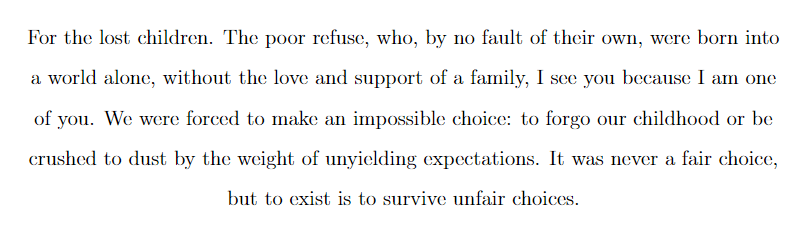
Bonus, bonus: If you’re someone I’ve interacted with even semi-regularly you’ve made it into my acknowledgments. But I’m not posting that because, well privacy and what not. Of course, the whole thing is under embargo for the next two years, so you probably won’t get to see it anytime soon.


 Lunatic Laboratories
Congratulations again on the publication of this book! I don’t think I ever told you what I thought of it. I mean I put a little “book report” on Twitter as I often do after reading something, but you probably didn’t see it. As I expected, it was eye-opening and meaningful; it was good to get so many perspectives on what it’s like to be in academia with a disability or chronic illness, and pick up hints about how the things others do can make that easier or harder. And some of the stories weren’t necessarily practical in that way, they were just … moving. Here is a thing that someone has gone through. Here is a part of reality.
Despite your trepidation, it sounds like you’re feeling good about your story and its presence in the book right now. I’m glad to hear that. I think it’s difficult to treat any story in isolation; most of the significant things that happen to us come from a lifetime of choices, even if that’s not immediately obvious. But the form you put it into for the book worked well – it wasn’t too large in scope, it wasn’t rambling.
Thank you for putting us in your acknowledgements. Awww.
LikeLiked by 1 person
October 2, 2023 at 12:21 am
You did it! Congratulations on all of your accomplishments and can’t wait to read about your new journeys.
LikeLiked by 1 person
October 2, 2023 at 5:50 am
Congratulations! I have loved following you! I hope you start a new blog! Best wishes
LikeLiked by 4 people
October 2, 2023 at 5:55 am
Have you started a new post? I’ve missed reading it. Did you see the 60 minutes about the Swiss doctor?
LikeLike
May 11, 2025 at 6:46 pm
Sorry! Things have been hectic. I do miss writing, hopefully I’ll be able to get back into it though. I see the interview with Courtine, he actually visit our lab a few months back. I’m hoping our approach will be better, but we’ll see. I hope you’ve been well, thanks for checking in!
LikeLike
May 27, 2025 at 5:37 pm