
Organic nanowires destroy the competition


Last month, we spoke of our vision of the future of humanity here at the lab. It makes sense that humanity would one-day step away from the static, non-living computer constructs we have designed. Moving us instead towards an organic alternative, one that can be readily repaired, replaced, or changed. While we cannot pretend to know what the future may hold, a new discovery helps bolster the stance we presented.
Nanodevice, build thyself


As we continue to shrink electronic components, top-down manufacturing methods begin to approach a physical limit at the nanoscale. Rather than continue to chip away at this limit, one solution of interest involves using the bottom-up self-assembly of molecular building blocks to build nanoscale devices.
Artificial ‘plants’ could fuel the future
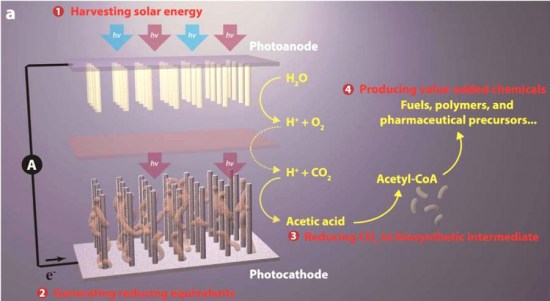
This schematic image of Chang’s artificial photosynthesis systems shows its four general components: (1) harvesting solar energy, (2) generating reducing equivalents, (3) reducing CO2 to biosynthetic intermediates and (4) producing value-added chemicals.
Image credit goes to: Berkeley Lab
Imagine creating artificial plants that make gasoline and natural gas using only sunlight. And imagine using those fuels to heat our homes or run our cars without adding any greenhouse gases to the atmosphere. By combining nanoscience and biology, researchers led by scientists at University of California, Berkeley, have taken a big step in that direction.
New therapy halts artery plaque growth and suppresses inflammation

According to the CDC, 1 in 4 deaths are due to heart attacks. In fact it is the leading cause of death for both men and women. Largely attributed to diet, most medications solely aim at lowering cholesterol. However, a research team showed that a nanotherapeutic medicine can halt the growth of artery plaque cells resulting in the fast reduction of the inflammation that may cause a heart attack, offering a new way to treat people at risk for heart disease.
Move over Carbon nanotubes introducing Diamond nanothreads
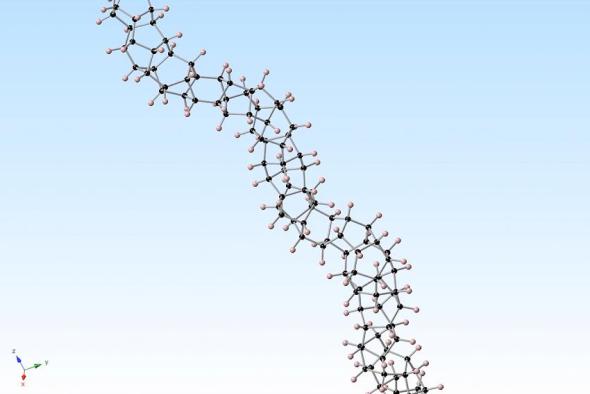
The core of the nanothreads that researchers made is a long, thin strand of carbon atoms arranged just like the fundamental unit of a diamond’s structure — zig-zag ‘cyclohexane’ rings of six carbon atoms bound together, in which each carbon is surrounded by others in the strong triangular-pyramid shape of a tetrahedron. Image credit goes to: Penn State University
Carbon nanotubes our hopes and dreams for the future have been firmly placed in using the unique material for everything from electronics to engineering. Unfortunately the production of carbon nanotubes has been hampered by setbacks, which as it turns out might not be a bad thing. This is because for the first time, scientists have discovered how to produce ultra-thin “diamond nanothreads” that promise extraordinary properties, including strength and stiffness greater than that of today’s strongest nanotubes and polymers.
Holy Grail of Battery Design: A lithium anode

Technology has been racing forward at an ever increasing rate. Unfortunately, anyone who owns a smartphone will tell you that the battery life doesn’t match the advancements. That is probably why engineers across the globe have been racing to design smaller, cheaper and more efficient rechargeable batteries to meet the power storage needs of everything from handheld gadgets to the new emerging electric cars. But a new breakthrough is about to [hopefully] change all that, a stable lithium anode.


 Lunatic Laboratories