
We can build it better: The First Semi-Synthetic Organism
Not anymore…
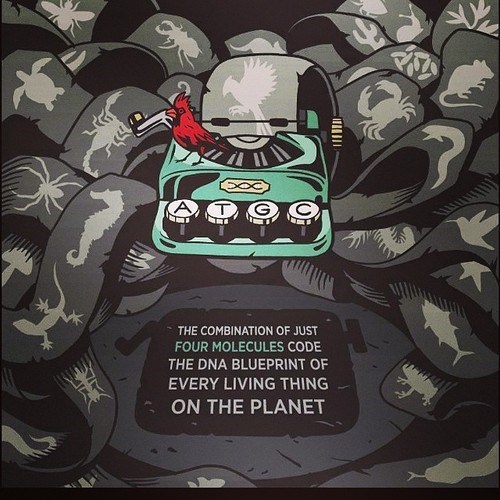
Normally I do one post a day, but I could NOT wait to share this. Scientists at The Scripps Research Institute (TSRI) have engineered a bacterium whose genetic material includes an added pair of DNA “letters,” not found in nature. The cells of this new bacterium can even replicate the unnatural DNA bases more or less normally, for as long as the molecular building blocks are supplied to the bacterium.
I don’t even really know where to start with this, so let’s start with the basics, normally in nature, everything, everywhere [that we know of] has four different letters in it’s DNA, A-T, G-C, that is is and they only go together in that order A with T and G with C, never will you see a T with a G for example.
Turning Back the Clock: Arteries

In what appears to be Fountain of Youth month here at Lunatic Laboratories, we have yet another way to turn back the clock, this time specifically for your arteries — at least that’s what University of Colorado Boulder are hoping with the new study they recently released.
When researchers gave mice [the human age equivalent of 70 to 80 year olds] water containing a specific antioxidant [MitoQ] for four weeks, they found that the arteries of those mice performed like arteries from mice with an equivalent human age of just 25 to 35 years.
Testosterone and your Heart: Don’t believe the hype

Testosterone, the “big T”, you can’t turn on the TV without someone talking about it. In fact, despite the bad [and almost completely false] press about the effects of testosterone, the amount of prescriptions in the US has tripled since 2001. Rightfully so, anyone on testosterone therapy will tell you how incredible the effects can be on day to day life.
Unfortunately testosterone therapy has it’s own smear campaign [analogous to the anti vaccination movement], surprising considering the number of people on TRT [Testosterone Replacement Therapy] I know. People throw around terms like roid rage [which is not real] when TRT is brought up, or depression, which as the evidence shows is the exact opposite of what TRT does [can you see my frustration yet?].
Another Road to the Fountain of Youth
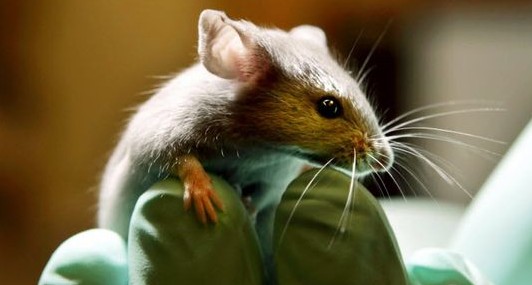
Photo credit goes to: Robert F. Bukaty, AP
Recently on Lunatic Laboratories we reported on a new path to the fountain of youth that had been found [at least for mice]. Well today, we are happy to announce that another road to the fountain of youth has been potentially discovered. This time the discovery was made by Harvard Stem Cell Institute [HSCI] and Stanford researchers.
Being the over achievers they are, they released not one, not two, but three studies showing that substances in the blood of young mice rejuvenate the brain and muscles of aging mice. Two of those three studies, by Harvard researchers were released early online just yesterday, but won’t be published until later this week in the journal Science. The two are similar to the third [albeit not connected], Stanford study that suggests the same reversal of aging also happens to their hearts.
5 Reasons Why Science is Losing the War

Science is losing an unseen war and like any war it isn’t without its casualties. The true body count won’t be evident, not at first. This isn’t a war over land, or freedoms, it is a war on ignorance, a fight for the future. Science has brought us a level of comfort and connectivity we have never really seen. Unfortunately that connectivity is being used against us, allowing people with dubious motives to shout from the rooftops bold faced lies and a call for people to follow.
The Fountain of Youth [Coming to a store near you]

The fountain of youth, as it turns out, isn’t so much a fountain, it’s a new drug. There has been countless dollars thrown at anti-aging research, some producing better results than others. So when scientists at northwestern medicine in collaboration with Tohoku University in Japan, released a new study I am sure there was more than one happy person seeing the results.
The team, building on previous research, have managed to extend the life of accelerated aging mice more than four times longer than the control group. All thanks to an experimental drug — not only did it extend the life, it also protected the lungs and cardiovascular system from aging.
Dear Science, I’m so sorry…


Dear America,
It’s a sad fact that being intelligent is now the “uncool” thing to do. Wanting to participate in learning and actually knowing how the world works can mean being bullied or worse. The backlash of this movement [I assumed] would be felt strongly starting with my generation [as an 80’s child]. I was unfortunately incorrect with this assumption, maybe it started a lot earlier. (more…)
Quantum Gravity Coming Soon… Maybe.
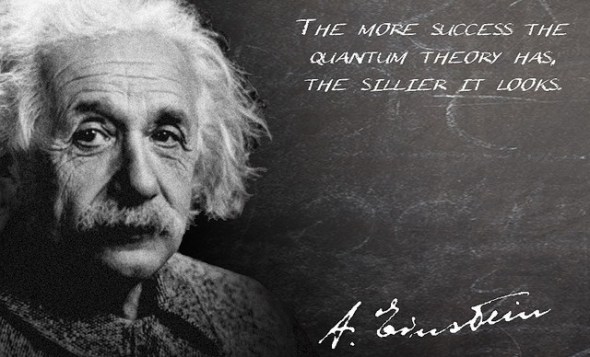
Don’t like quantum mechanics? Don’t worry Einstein didn’t either. In fact, not only did Einstein not like quantum mechanics, neither did his general theory of relativity. Which was okay… sort of. Quantum mechanics involves things that are really small, while relativity dealt with things that are really large and never the two shall meet, that is, until they do.
It’s not Einsteins fault that the two theories don’t play well together. They are both mathematical formulas, there is no malice involved. Einsteins world was beautiful and solid, he wanted to use math to form a world made of granite, smooth, shiny and perfect. Quantum mechanics on the other hand is uncertain, that is a fundamental principle, it’s more like wood, it’s not pretty, rough and textured.
Mantis Shrimp, is there anything you can’t teach us?
![Image from a webcomic [yes there is more!] by- TheOatmeal](https://loonylabs.org/wp-content/uploads/2014/04/mantis-shrimp.jpg)
Image from a webcomic [yes there is more!] by- TheOatmeal
The mantis shrimp for those of you who did not read the awesomely done comic by TheOatmeal has some of the most unique talents in the animal kingdom. Namely it’s tenacity for killing things with it’s powerful clubs.
Is being a human conservationist selfish?


Earth day, it’s a lot like new years. You make resolutions that you will never follow, promise yourself you will attempt to do things you really don’t want to, and try to do without that thing you know you can live without, but can’t seem to do it.
Yesterday was Earth day, so happy belated earth day, I guess… So how about the state of the planet then? It’s the only one we have, it is the place we call home, and unless you want to deal with chest bursting aliens [hey, I’ve seen the movies] then we are stuck here.
Alzheimer’s? Forget about it!

Just one of many horrible diseases of the brain.
Let’s face it, diseases that affect the brain are some of the hardest to deal with. Anyone who’s lost someone to alzheimer’s knows exactly what I am talking about. Looking at someone you love and watching them slip away without any visible difference can be heart wrenching!
However, there is a new hope! Physicists [of all things] from Michigan State University published an article in the Journal of Biological Chemistry, that might make alzheimers and associated diseases a thing of the past.
Self-Healing Composites- The Trick is Biology
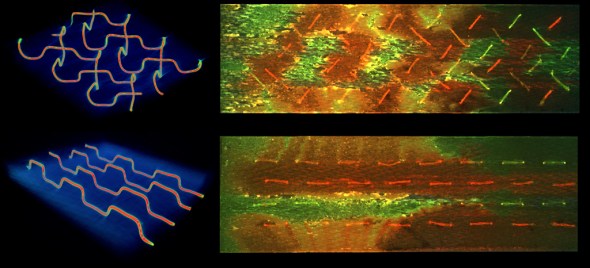
3D microvascular networks for self-healing composites: Researchers were able to achieve more effective self-healing with the herringbone vascular network (top) over a parallel design (bottom), evidenced by the increased mixing (orange-yellow) of individual healing agents (red and green) across a fracture surface. Photo Credit: University of Illinois
Let’s face it, things wear out. Car tires go bye-bye, seals get worn, and Jets need constant upkeep to make sure that cracks in the fuselage [the main body of an aircraft] don’t become points of failure. Thanks to a new technique right out of the labs at the University of Illinois, things may still wear out, but they will also self heal.
Global Warming Natural? Don’t bet on it.

Analyzing the temperature data as far back as 1500 almost completely rules out the idea that global warming is a natural phenomena and that human intervention plays no role. That is the punch line to a new study that was recently released.
The study, published April 6th in the journal Climate Dynamics, offers a new approach to finding a solution to the question of whether global warming is natural, or if it is caused by man. Instead of looking complex computer models of greenhouse gases in order to estimate the effect, McGill University physics professor, Shaun Lovejoy examined historical data as a statistical model to assess the competing hypothesis: that warming over the past century is due to natural long-term variations in temperature.
The Future of Fusion Funding
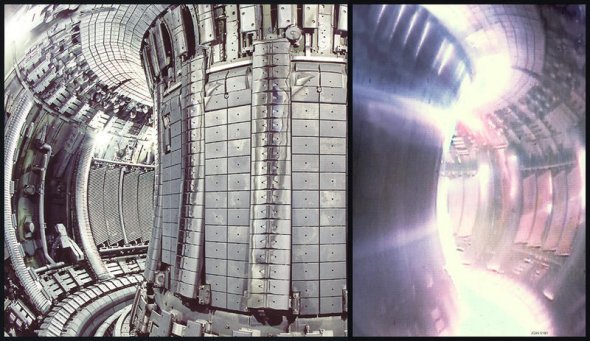
Photograph Courtesy of EFDA-JET
Fusion, the promise of clean, renewable energy has been so powerful that scientists have been chasing the dream for roughly 50 years now. Since the birth of atomic energy and the realization of the immense power hidden hidden in the atom, commercial fusion energy has always been 20 years away.
In one of the most ambitious fusion projects global leaders came together to construct the world’s largest fusion plant– ITER [International Thermonuclear Experimental Reactor], in the hopes that scaling the technology to a larger size will be key in producing a fusion reaction that creates more energy than it takes to sustain the reaction.
DARPA wants Biotech Companies
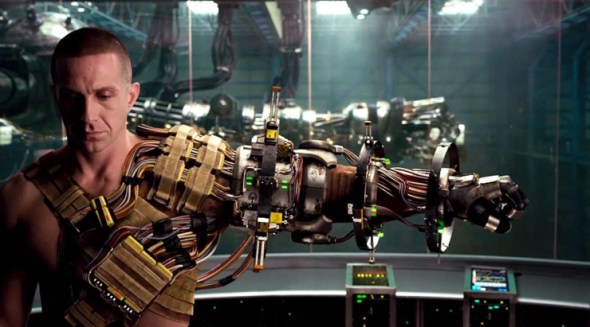
Science fiction… for now.
DARPA [Defense Advanced Research Project Agency] has a long history of making high-risk, high-reward moves. After all, they have helped shape the field for prosthetics, they have been pushing for big battlefield medical advancements and in 1997, they made a large effort to combat biological hazards.
Scientists cure Muscle Paralysis in Mice
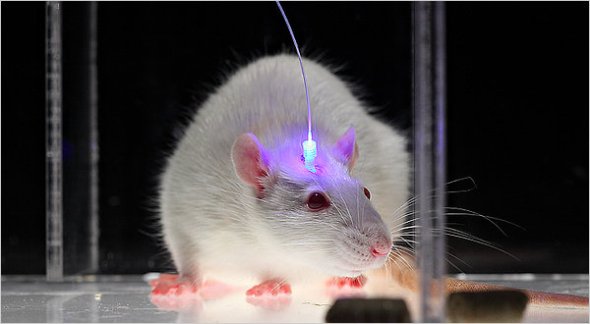
Photo credit: John Carnett/Popular Science – Optogenetics, tested in rodents, can control electrical activity in a few carefully selected neurons.
Searching for a new way to cure paralysis, a team of scientist has come up with a remarkable and off the wall idea. This discovery comes out of the labs at the University College London. The team, lead by Linda Greensmith, used stem cells and optogenetics to control leg muscles in mice and completely circumvent the nervous system in the process.
For those of you who are not familiar with Optogenetics [and really, why would you be familiar with it?] here is a overly simple rundown of what we are talking about.
Gene Editing in Live Mice Cures Rare Liver Disease


A chromosome [the “x”] with a DNA strand ‘close up’ in the circle.
The [real life] Doomsday Vault


The real life entrance to the real life doomsday seed vault.
It sounds like something out of a sci fi movie, a vault that is designed to withstand the end of days. A ‘doomsday vault’, tucked deep in a mountain, designed to be self sufficient and keep it’s contents protected and safe for decades if not millennia.
From the outside it looks like some secret military bunker. A solid concrete tube that juts out of a mound of snow; a chain on either side of a ramp acting as a guide to the entrance, a man made object in the middle of nothingness.
Cyberdyne, Google, and the Rise of Drones
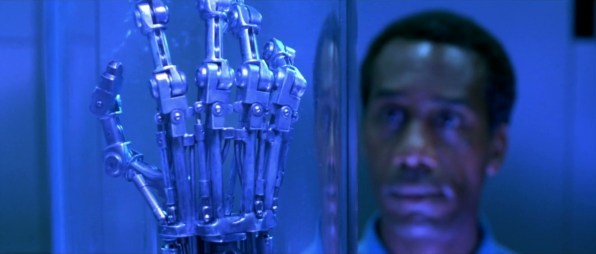
Set in a futuristic dystopian world where humans are pitted against advanced robots controlled by an AI, Terminator plays out like the hollywood blockbuster it turned out to be. Set to pit a person’s innate fear of the unknown against the fear of technology itself, it was a big hit.
Any good apocalyptic movie needs to have a grounding in reality before it can take the leap from ordinary to extraordinary, but when events slowly play out, that are eerily similar to the movie, should you be worried?
Monkey Mind Control

Monkeying around…
What does a rhesus monkey and a the Blockbuster Hollywood film Avatar have in common?
They both use mind control to operate an ‘Avatar’.
Researchers at Massachusetts General Hospital placed a neural implant on the ‘master’ monkey that could monitor up to 100 neurons, this allowed the ‘master’ money to control a second ‘avatar’ monkey.
To test this. they trained the ‘master’ monkey to use a joystick and find a target on the screen.
Prosthetic hand gives amputee feeling again
![Amputee Dennis Aabo Sorensen tests the prosthetic hand in Rome last year. Photo credit [and caption] goes to the independent](https://loonylabs.org/wp-content/uploads/2014/02/amputee.png?w=590)
Amputee Dennis Aabo Sorensen tests the prosthetic hand in Rome last year. Photo credit [and caption] goes to the independent
Hook or hand?
Those are your choices, do you want a fake non-movable plastic hand, or would you prefer the hook? At that point you are probably wondering why they are now making smartphone watches, but you are stuck getting [almost] the same technology that was used during the civil war.
Tired of the weather? Blame the jet stream.

Polar vortexes, snow storms and hurricanes, oh my!
Who’s tired of the crazy weather that most of the US and the UK are dealing with? I suspect that most are, in fact I don’t remember the last time I heard someone talk excitedly about being snowed in.
There is good news and bad news though, and like a true gentleman I will give the good news first. We know what is causing the weather changes we’ve seen.
It’s a swarm… of robots?!
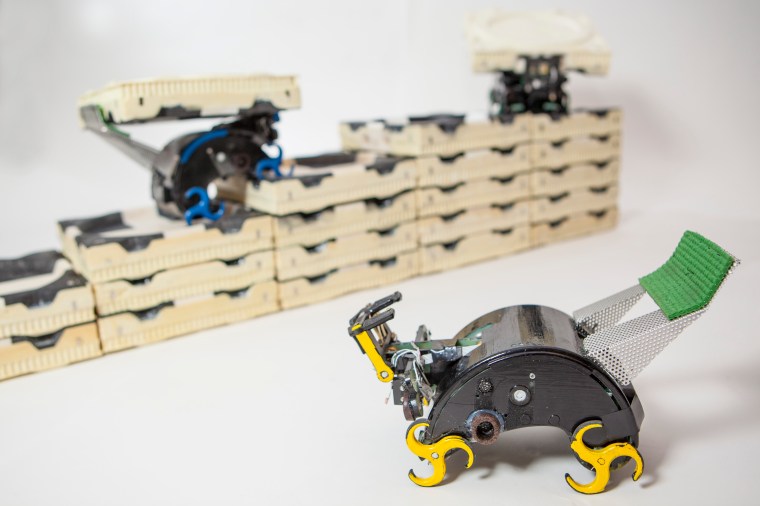
The rather cute TERMES robots doing their thing. Photo credit goes to Eliza Grinnell, Harvard SEAS
You’ve seen a swarm of bees, you’ve seen a swarm of ants. But now, a research group at the Harvard School of Engineering and Applied Sciences have introduced us to a new kind of swarm, a swarm of robots.
The idea stems from, of all things, termites.
Normally, when you have any sort of large scale building operation, like a home for example, you have someone in charge telling each individual what to do. There are specialized functions for each person, a electrician, a carpenter, etc and if one of them walks out on the project, the project is stalled until they are replaced.


 Lunatic Laboratories