
Day 261: On Being a Mentor


One of the many hats I wear as a PhD candidate is my mentor hat. It’s probably one of my favorite jobs and I get to work with some truly brilliant people from all types of backgrounds. I’ve had the chance to mentor a small handful of people and I always look forward to learning from them and through our interactions, in that sense, it’s a mutually beneficial relationship.
Day 260: The thing about endings


…and thus our mighty hero slay the beast and rode off into the sunset to live happily ever after. But why? Have you ever really thought about the way some stories choose their endings? Our hero goes through live altering and extremely daunting challenges only to brush it off like he caught the wrong bus. Pardon me, but what the actual fuck?
Day 259: The Postscript

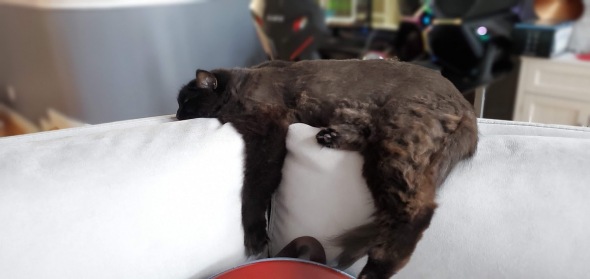
After awhile you supposedly end up resembling your pet, I think it’s happened. She looks how I feel.
I just want to sleep for fifty years, is that so much to ask for? The deadline is gone whence it came! That does not mean it wasn’t a fight to the end or that there is a weird stillness permeating the house like a calm after a storm. What is it about things ending so abruptly that throws a person into a spiral of confusion?
Day 258: The deadline

It’s here.
If you’re reading this, then it is already too late. It’s here, do you feel it? It’s in the house… the deadline. It’s a sneaky dark and evil thing from a time forgotten, but you can feel its presence long before it arrives. It whispers in your ear as you sleep, or did it? Of course, there isn’t anything there for real, right?
Day 257: Tomorrow…


Well we’re up against the wire now. Tomorrow is the due date for my paper and with it the video I am working on. Will I make it? How much work is left to do? Why am I talking in questions? Find out more… now…?
Day 256: Two days left…


A live shot of me waiting for my data to finish processing
Well here we are and it’s… ♫ the finalllll count dowwwwwn!! ♫ My paper is due sunday at midnight and between the video I need to make, the data that still needs to be processed, and a shitty team mate who has done absolutely nothing to help, well I’ve got my work cut out for me.
Day 255: The impossibility of complete knowledge


Have you ever tried to learn something and you just can’t seem to get it to stick in your brain? That would be my life, well most of my adult life since I left the Marines. There is just so much knowledge in the world and wrapping my brain around even a fraction of a fraction of a fraction of that knowledge seems to be an impossible task. So what is one to do?
Day 254: Review – A Brain to Spine Interface for Transferring Artificial Sensory Information
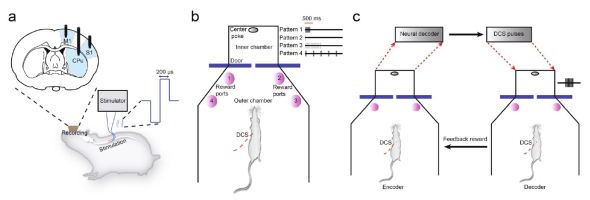
Experimental setup for artificial sensory discrimination using DCS and brain-to-spine interface. (a) Rats were implanted with recording electrodes in motor cortex (M1), somatosensory cortex (S1) and striatum (STR) and dorsal column stimulating electrodes in the thoracic epidural space. (b) Behavioral setup for artificial sensory discrimination using DCS (c) Setup for the brain-to-spine interface consisted of two modified aperture width tactile discrimination boxes.
If you ever were to read one of my review papers, this one’s for you. It’s so awesome and falls in line fairly closely to the things I want to accomplish, albeit going a different route to get there. I’m super excited to share this with all of you and I hope I did the study justice in my summation and while I admit, I had far too much enthusiasm with this one, it shouldn’t take away from just how amazing this is, see for yourself! The study is open access too, so if you want to know more details, you can go take a look!
Day 239: Review – Burst-modulated waveforms optimize electrical stimuli for charge efficiency and fiber selectivity
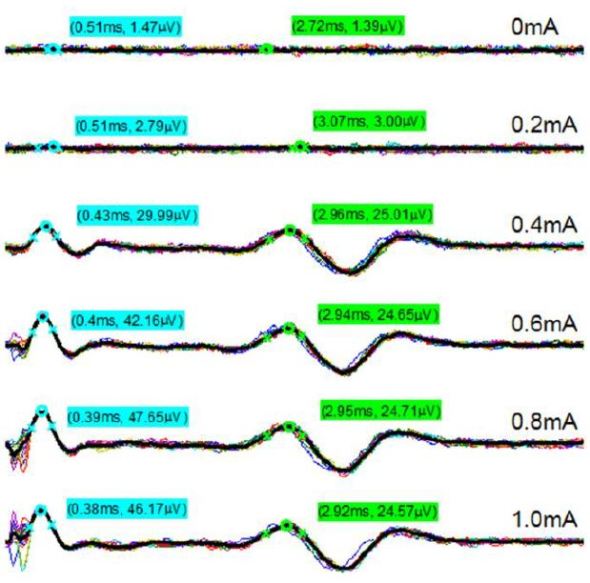
Example processed nerve responses during stimulation trials. The individual CNAP responses for each stimulus (thin traces) were averaged (thick trace, n=20 stimuli). All traces are shown from time 0 to 6ms. The top trace corresponds to an amplitude of 0, the bottom 1mA, and the traces in between are arranged in increments of 0.2mA. Peak latencies and heights (o’s) and widths at half peak height (x’s) were extracted from the averaged signal. The peaks labeled for the 0mA trial are due to noise and baseline activity. These peaks are not actual response peaks from the nerve and are ignored.
Another two weeks, another critical review and as always since my PI gets a copy, so do you. Technically this should’ve come yesterday, but I really wanted to follow up with the Roosevelt mess going on. In any case today we are looking at something not quite spinal cord stimulation, but has applications in the spinal cord stimulation field. Let’s take a look!
Day 224: Review – Cortical and Subcortical Effects of Transcutaneous Spinal Cord Stimulation
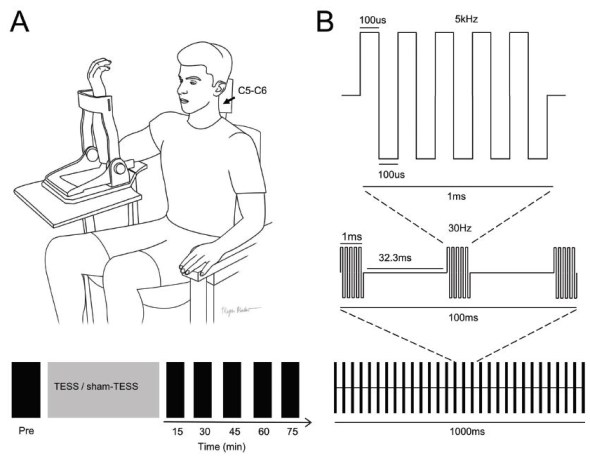
Experimental set-up. (A) Participants were comfortably seated in a customized chair during transcutaneous electrical spinal stimulation (TESS) or sham-TESS for 20 min. TESS was delivered using a surface electrode on the back of the neck between C5–C6 spinous processes segments (cathode) and a surface electrode in each anterior crest of the hip bone (anode) using a custom made 5 channel stimulator (BioStim5, Cozyma). Electrophysiological and behavioral outcomes were tested before (Pre) and immediately after, 15, 30, 45, 60 and 75 min after the end of the stimulation or sham stimulation period. (B) Schematic representation of the type of current used during TESS. We used 5 biphasic pulses at 5kHz with each biphasic pulse lasting for 200us. The middle scheme shows the blocks of 5 biphasic pulses passed at a 30Hz frequency. Lower part of the schematic shows the number of pulses delivered in one second.
Well it’s been two weeks since the last critical review so it’s that time again. As usual, my PI gets a copy and so do all of you. Since I’ve done several of these now (this is number six) I have a category just for these reviews called critical reviews. This is a really new study which tries to help tease apart what we are actually stimulating when we apply transcutaneous spinal stimulation. I think it’s a super interesting paper and I hope you do as well.
Day 210: Review – Cervical trans-spinal direct current stimulation: a modelling-experimental approach
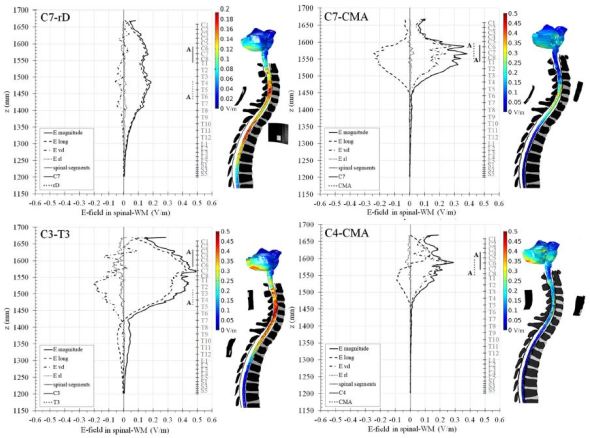
Average magnitude of the E-field and average amplitude of its components in the spinal-WM in all montages along the z axis. Position of spinal segments is marked on the grey vertical bar, electrodes are represented by vertical bars and active connectors are marked with letter “A”. Volume plots of the E-field magnitude in cervico-thoracic spinal-WM, brainstem and cerebellum are represented at the right of the average distribution in each montage, with the corresponding colour scales
I lied! I did know what today was going to be on, it’s the fifth critical review paper. Since my PI gets a copy, so do you! To be honest, I need to create a category for these reviews (Update: I did make a category, Critical reviews), but for now, my first looking at elbow spinal stretch reflexes is here. My second where I review modulating spinal cord excitability with a static magnetic field here. The third where I review modulating the H-reflex while walking in spinal cord injury populations. Lastly, my fourth on Motoneuron excitability during voluntary muscle activity in a spinal cord injury population can be found here. That said, let’s take a look at my latest review.
Day 196: Review – Changes in Motoneuron Excitability during Voluntary Muscle Activity in Humans with Spinal Cord Injury
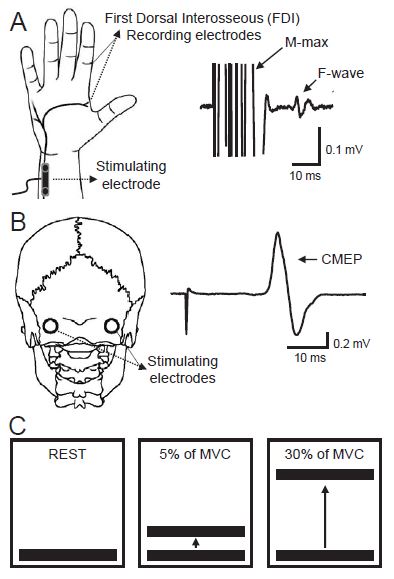
Figure 1. Experimental setup. A, Schematic representation of the hand showing the ulnar nerve and F-waves recorded from the first dorsal interosseous (FDI) muscle. B, On the left side, schematic representation of the head showing the electrodes placed at the cervicomedullary junction and on the right side a raw trace showing a cervicomedullary motor evoked potential (CMEP). C, A cartoon showing the concept of the visual feedback. Individuals were tested at rest (left single horizontal line) and during 5% (middle double horizontal lines) and 30% (right double horizontal lines) of maximal voluntary contraction (MVC).
A little detour from our spinal cord series for my fourth critical review paper. As usual, my PI get a copy and so do all of you! You can read my first looking at elbow spinal stretch reflexes here. My second where I review modulating spinal cord excitability with a static magnetic field here. Or the third where I review modulating the H-reflex while walking in spinal cord injury populations. Today is an interesting paper on motoneuron excitability while walking in spinal cord injury populations. It’s a really cool paper, so here’s my review.
Day 182: Review – Modulation of soleus stretch reflexes during walking in people with chronic incomplete spinal cord injury
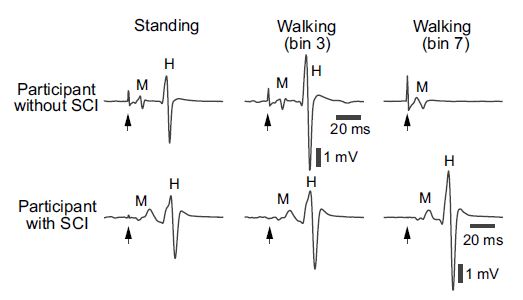
Figure 2 of the paper showing examples of the soleus H-reflex (labeled H) during standing and during different phases of walking in a participant without known neurological injuries (top) and in a participant with chronic incomplete SCI (bottom).
Today is my third attempt at a critical review paper. Since my PI gets a copy, so do all of you! You can read my first looking at elbow spinal stretch reflexes here. Or my second where I review modulating spinal cord excitability with a static magnetic field here. Today is an interesting paper on soleus stretch reflex and H-reflex. I really appreciate the methodology the researchers used and they did an excellent job of highlighting the limitations to the study, which is always important. Per the usual disclaimer, this is my third critical review, so you can take my opinion n the methodology and findings how you will. (more…)
Day 168: Review – Static magnetic field stimulation applied over the cervical spinal cord can decrease corticospinal excitability in finger muscle
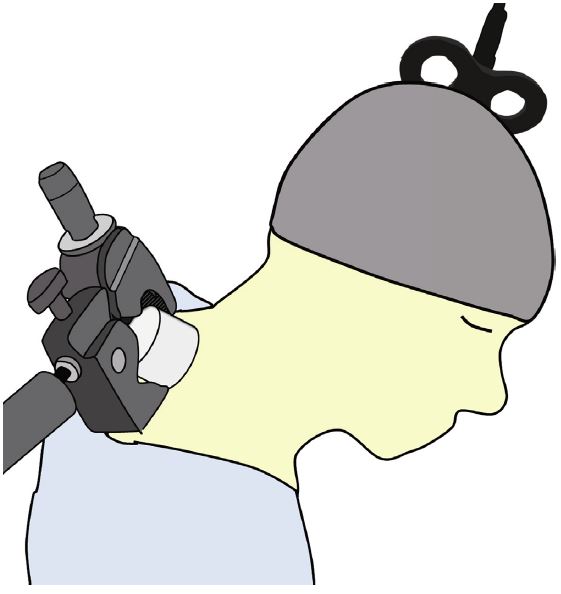
Figure 1 of the paper showing how the intervention was applied to the spinal cord
As mentioned in yesterday’s post, this is my second critical review paper. You can read my first looking at spinal reflexes here. Today we are looking at a novel way to modulate spinal cord excitability. Overall I find the paper very interesting. Although the authors performed a limited experiment and no follow up (as of now) has been done, it still looks very promising and would provide a new way to explore the circuitry of the spinal cord. This is my second attempt at a “critical review” so you can take my opinion on the methodology and findings how you will.
Day 154: Review – Spinal stretch reflexes support efficient hand control
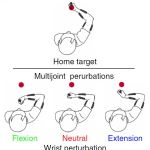
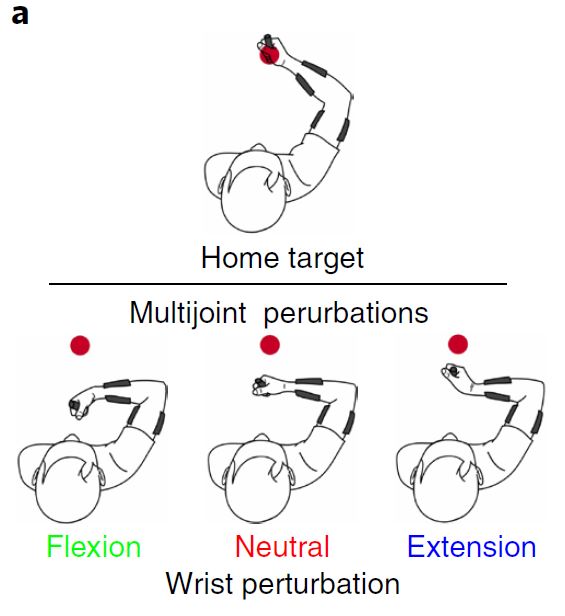
Fig 1 (a) from the paper, showing the multijoint perturbation away from target (red) with simultaneous flexion at the elbow and either flexion, extension, or no perturbation at the wrist joint.
Today is that critical review paper I promised. Everything following this introduction explains how the experiment was done, what they found, and why I think it is particularly interesting. To me the experiment was so well thought out I couldn’t think of anything I would change. Instead I focused on the methodology they used and why it highlights the importance of a well thought out experiment. This is really my first attempt at a “critical review” so take it how you will.
Day 153: The week ahead


Tomorrow is more experiments! We’re doing all the experiments tomorrow. Okay, not all of them, but we have an ambitious three experiments lined up for tomorrow so it will definately be a long, long day. Still recovering from surgery too… so yeah it’s going to be a time. There are a few other things going on this week, so let’s look ahead and maybe talk about what I’m thinking of doing for the next round of themed posts (educational topic posts).
Day 152: Improving my writing


One of the outcomes of my recent meeting with my PI (my main one), is that I am going to be actively working on my writing. While I do this to improve my writing, this is far more informal than the writing I would be doing for a confrence or journal paper (both of which I’ve written). That isn’t to say that I cannot improve, there’s always room for improvement and I could use a LOT of improvement.


 Lunatic Laboratories