
Know your spinal cord – The anterior white commissure
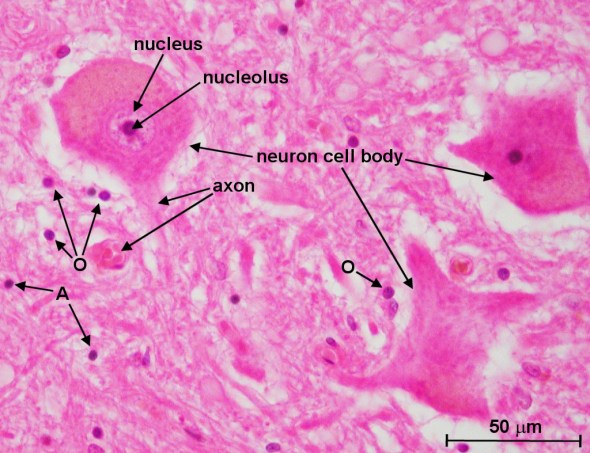
Cross section through human spinal cord (lumbar region, L1) showing motor neurons. Astrocytes and oligodendrocytes are labeled ‘A’ and ‘O’, respectively. The objective magnification used is 40x.
Welcome to day thirty of knowing your spinal cord. I feel like that is a lot of spinal cord knowledge for just covering the basics. In any case, if you’re just finding us, welcome! I’ve created a whole new neuroanatomy category just for these posts so you can find them easy and they are in reverse chronological order. Is the anterior white commissure a tract of the spinal cord? Well not really, but it does have an important job and we keep referencing it, so let’s talk about what it does exactly.
Know your spinal cord – The spino-olivary tract
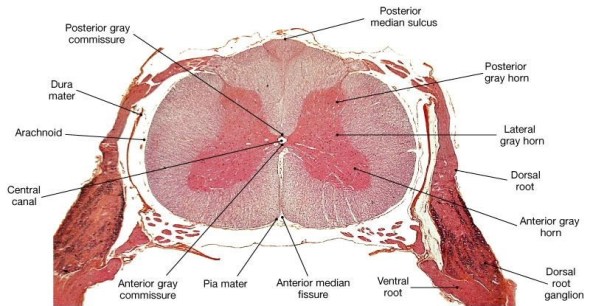
Spinal cord anatomy
Day twenty-nine, wow does time fly! We have over four weeks worth of fun spinal knowledge for you to tap into, all in reverse chronological order in our handy neuroanatomy category! If you read the title, you know we’re back on tract (see what I did there?). Today we’re talking the spino-olivary tract, or is it the olivospinal tract? Keep reading to find out!
Know your spinal cord – Cauda equina syndrome
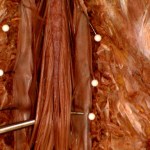
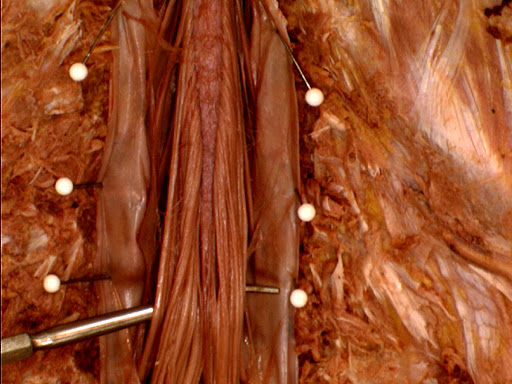
Here we are on day twenty-eight of knowing your spinal cord. A friendly reminder, the entire series has its own neuroanatomy category where you can catch up on any posts you missed or if you just want a reminder on something we already covered. We’ve already covered quite a bit of spinal disorders, but there is one more that I want to talk about and like our series where we started at the top of the cord and worked our way down, we are now going to cover damage to the bottom of the cord, specifically the cauda equina.
Know your spinal cord – Motor neuron disease
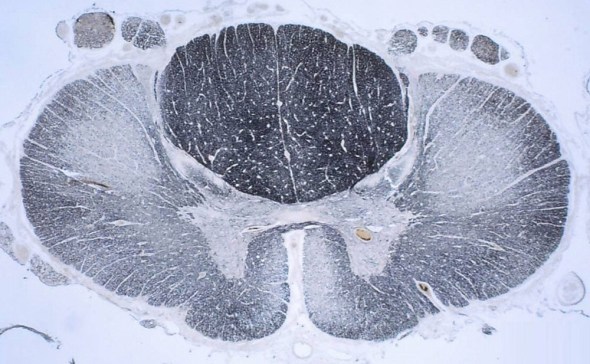
Kultschitzky staining was used here and shows marked symmetrical demyelination (whitening regions) in the anteriolateral roots (especially pyramidal tract) of the spinal cord
It’s day twenty-six already! For those of you who are just finding us, you can find all of the posts in our super cool neuroanatomy category. We’ve already covered a lot of spinal disorders, but one of the larger diseases that we have yet to cover is motor neuron disease. Technically a family of diseases, we will look at the commonalities and causes, so with that introduction, let’s get going.
Know your spinal cord – The H-reflex
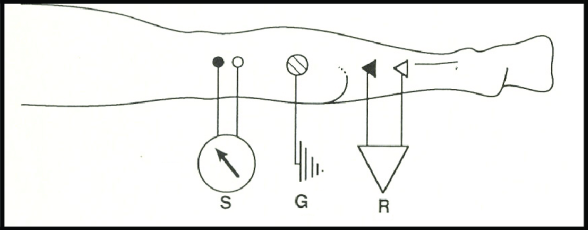
We measure the H-reflex by applying an electrical stimulus (S) behind the knee, the ground (G) gets placed around the soleus and the recording electrode (R) is placed inline below, this is the route the nerve takes.
Yesterday we had a bit of a break so I could share a critical review paper. That means this is day twenty-five of the know your spinal cord series! We’ve also hit the halfway mark in our 365 days of academia challenge! If you’re new here, you can find all of the fun spinal cord knowledge we’ve amassed by checking out our neuroanatomy category! We are going to take a step away from spinal cord disorders to talk about something we kind of covered, but deserves a more in-depth exploration. This is all you wanted to know about the H-reflex, so let’s dive in.
Know your spinal cord – Tabes dorsalis

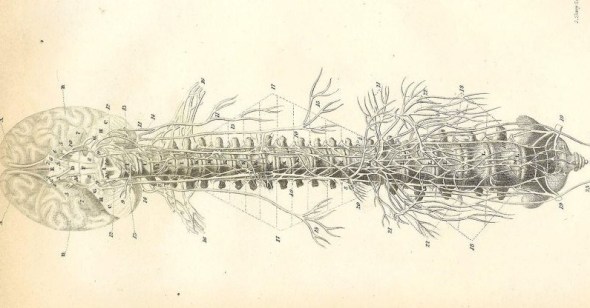
We’ve made it to day twenty-four of fun spinal cord knowledge! If you’re just joining us, we have a whole new neuroanatomy category for you to find all the posts in this series in reverse chronological order. If you want to know everything, then you’ll want to start at the beginning with the medullary pyramids. Over the past week in our series we’ve been talking about spinal cord disorders and today we are looking at something called tabes dorsalis, let’s begin!
Know your spinal cord – Lichtheim’s disease
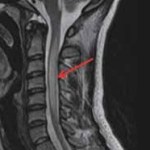
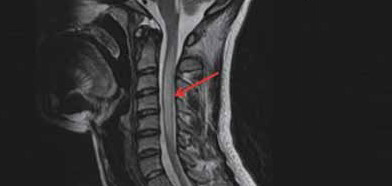
MRI showing Lichtheim’s disease caused from nitrous oxide (we show another case below)
It’s day twenty-three in our little series called know your spinal cord. For those just finding us, you can read the rest of the posts in our special neuroanatomy category created just for these posts! If I’ve counted correctly, this will be the seventh post on different spinal cord disorders and today we are covering something called Lichtheim’s disease, so let’s take a look.
Day 114: Classifier Update
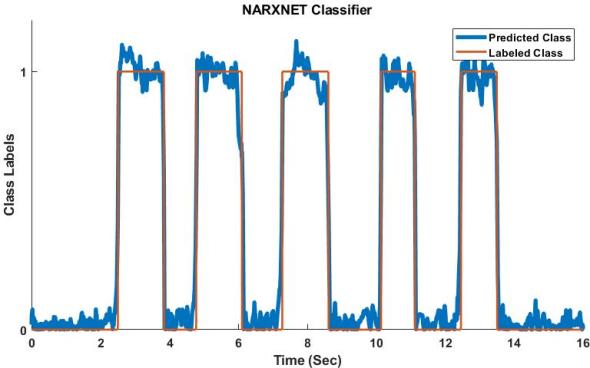
Behold! My amazing predictive power!! *insert evil laugh here*
It’s been a long and exhaustive road to get to here. As you may recall, I’ve given several updates already on my progress and I THINK I’ve finally hit success. In fact, I know I have, the problem now? Well what the neural net saw to make the predictions is a mystery to me, so I don’t know why or how it works… yet.
Day 54: The Science Behind Real Zombies


Time for a break from stochastic processes, at least for the moment. Every year here we update and post our favorite Halloween tradition! So today we bring you the science fact and fiction behind the undead. Zombies, those brain loving little things are everywhere. Sure, we are all familiar with the classic zombie, but did you know that we aren’t the only zombie lovers out there? It turns out that nature has its own special types of zombies, but this isn’t a science fiction movie, this is science fact! Sometimes fact can be scarier than fiction, so let’s dive in. Let’s talk zombies.
Synthetic biology breakthrough creates biosensors on demand


Biosensors are powerful tools in synthetic biology for engineering metabolic pathways or controlling synthetic and native genetic circuits in bacteria. Scientists have had difficulty developing a method to engineer “designer” biosensor proteins that can precisely sense and report the presence of specific molecules, which has so far limited the number and variety of biosensor designs able to precisely regulate cell metabolism, cell biology, and synthetic gene circuits.
What’s that!? Brain network that controls, redirects attention identified

Researchers at Columbia University Medical Center (CUMC) have found that key parts of the human brain network that give us the power to control and redirect our attention–a core cognitive ability–may be unique to humans. The research suggests that the network may have evolved in response to increasingly complex social cues.
Long-term memories are maintained by prion-like proteins


Research from Columbia University Medical Center (CUMC) has uncovered further evidence of a system in the brain that persistently maintains memories for long periods of time. And paradoxically, it works in the same way as mechanisms that cause mad cow disease, kuru, and other degenerative brain diseases.
Digesting bread and pasta can release biologically active molecules
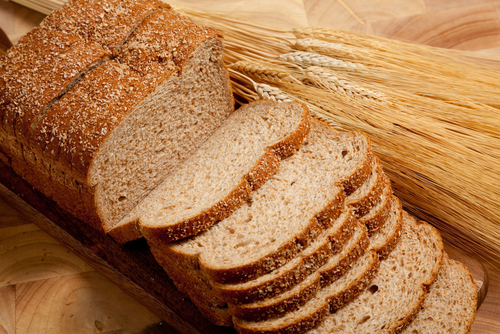
Biologically active molecules released by digesting bread and pasta can survive digestion and potentially pass through the gut lining, suggests new research. The study reveals the molecules released when real samples of bread and pasta are digested, providing new information for research into gluten sensitivity.
Study finds pet owners reluctant to face up to their cats’ kill count
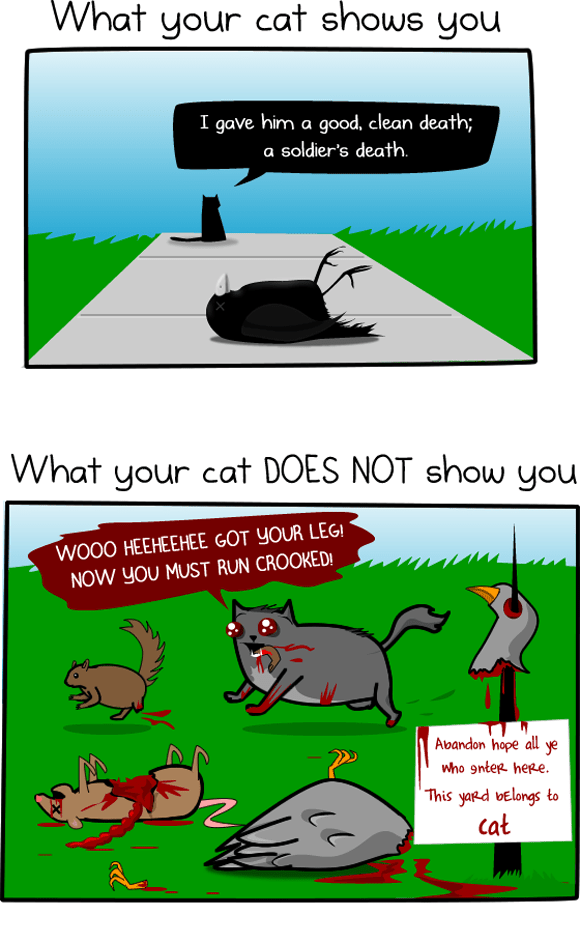
More awesomeness like this can be found at theoatmeal.com
Cats are increasingly earning themselves a reputation as wildlife killers with estimates of animals killed every year by domestic cats in the UK numbering into the millions. This new study on the attitudes of cat owners suggests that proposals to keep cats indoors in order to preserve wildlife would not be well received.
Milk proteins may protect against cardiovascular disease
 The Maillard reaction is a chemical reaction between amino acids and reducing sugars that results in browned foods like seared steaks and toasted bread. When proteins and sugars are mixed together and heated, new chemical compounds are formed. Some are responsible for new flavors and some, according to a new study, may protect us against cardiovascular disease. (more…)
Researchers find essential fats for brain growth
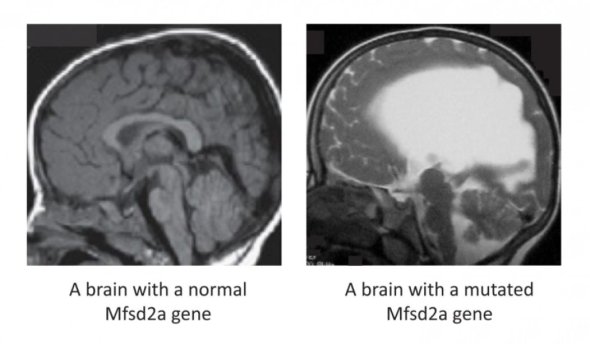
The difference between a brain with a normal Mfsd2a gene and a brain with a mutated Mfsd2a gene.
Image credit goes to: Guemez-Gamboa et al./ Nature Genetics
New research has proved that certain special fats found in blood are essential for human brain growth and function. The two studies showed that mutations in the protein Mfsd2a causes impaired brain development in humans. Mfsd2a is the transporter in the brain for a special type of fat called lysophosphatidylcholines (LPCs) — composed of essential fatty acids like omega-3. These studies show, for the first time, the crucial role of these fats in human brain growth and function.
Which is most valuable: Gold, cocaine or rhino horn?

These are elephants in Botswana. Image credit goes to: Blaire Van Valkenburgh
Many of the world’s largest herbivores — including several species of elephants, rhinoceroses, hippopotamuses and gorillas — are in danger of becoming extinct. And if current trends continue, the loss of these animals would have drastic implications not only for the species themselves, but also for other animals and the environments and ecosystems in which they live, according to a new report by an international team of scientists.


 Lunatic Laboratories