
Day 250: Maximum Likelihood Estimation

If we are going to talk about expectation maximization (now that I’m done complaining for a bit), we are going to have to introduce the idea of maximum likelihood. It’s going to be very easy to introduce, but it is a very powerful tool in estimating the state of something. Of course, it takes understanding a little bit of statistics, but trust me, if I can understand it, so can you.
Day 249: A stern email later…


Photo of me responding to his email …
I don’t want to jinx it, I really don’t, but I have an update on my group member situation and it isn’t completely awful! I mean, I’m still doing all the work and blah, blah, blah, but I’ve got an interesting story and I hope that things will be better now.
Day 248: A Virtual Conference

Every zoom meeting I try to break my PI and get him to laugh, this was my last attempt, still nothing… my work continues.
This will be my first conference since the pandemic and it will be a virtual one. To be completely honest, it wasn’t until yesterday that I was reminded we had one today. It’s a little bit different from our normal routine and I think that is what is throwing me off.
(more…)
Day 247: The Kalman filter – Part 2
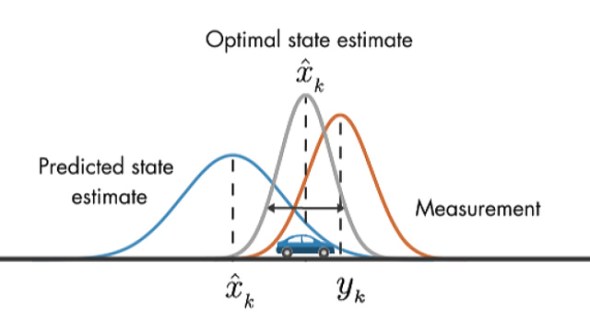
The Kalman filter converges on the optimal state estimate using noisy measurements and a model that we create.
Okay I lied, I think we can do a better job explaining the Kalman filter, more importantly I have a fun little demo I can share with everyone. It’s not mine, but I like it a lot and it will give you a feel for what the kalman filter does. So let’s get started!
(more…)
Day 246: The Kalman filter
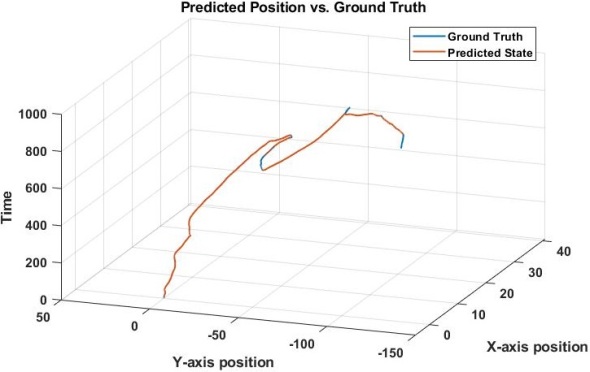
This is just one application for the Kalman filter, I estimated a two dimensional position using a random walk model. We have 3-dimensions here even though it is a 2 dimensional problem, the third dimension is time. This way we can see the path over the course of the recorded time. Notice there are no units, becuase in this case we were working with synthetic data so the units were meaningless and I did not include them.
Since we’ve been talking a lot about it, I thought it might be a good idea to formally introduce the Kalman filter. This will be a semi-high level introduction (like my knowing your spinal cord series), but at the end of it you should have a relatively good feel for what a Kalman filter is.
(more…)
Day 245: Fine, I’ll do it myself.

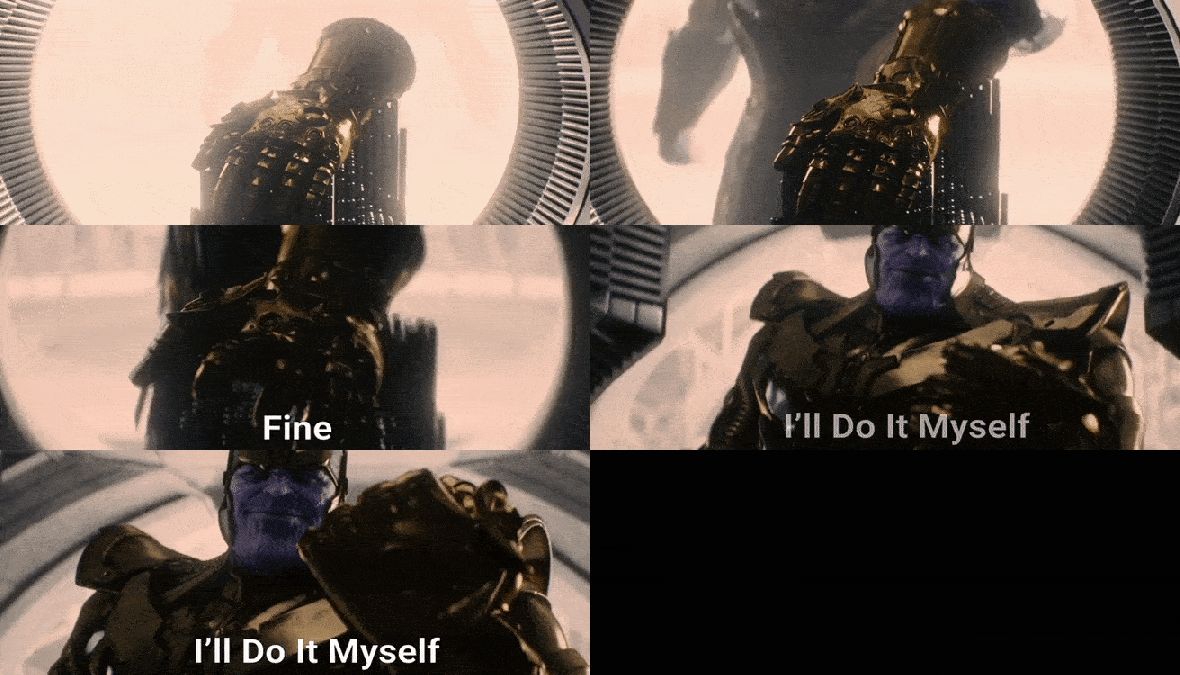
I will not fail this class becuase of a shitty team member. I will not allow it, I’ve put too much effort and time into this class to do poorly at the last minute because my team member can’t be bothered to do the job he agreed to do. I suppose, this was… inevitable.
Day 244: The end of the term!?


Okay, where the hell did that come from?! It’s almost the end of the school term. WHAT THE HELL!? It feels like we just got started, but my instructor just sent out the final assignment, which is due the last week of school… next week. I’m sort of freaking out right now.
Day 243: Deadlines approaching!


It seems like it’s been non-stop for me left and right. I have experiments to do, papers to write, and classes to work on. With the pandemic I was hoping to get a chance to take a break, but nope it seems like I’m even busier than normal. I HAD thought that I was caught up finally when I finished processing some of the experimental data I had laying around, but nope I was reminded yesterday that I had not one, but two major deadlines coming.
Day 242: Experimenting in the time of a pandemic
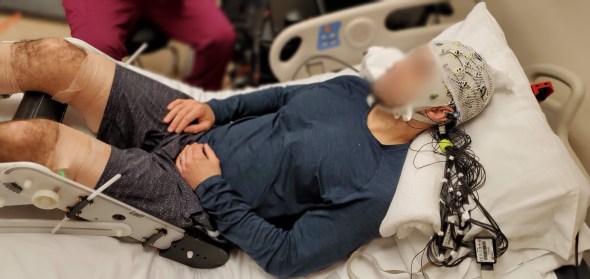
Another day forward in our new normal. I’ve left the house exactly once in the last two weeks and while it’s nice not having to commute to school, I do miss living in a world without the constant fear of catching the virus. What day is it? Who knows, it doesn’t matter anymore. I do have some things coming up though, so let’s talk about experimenting in the age of COVID-19.
Day 241: Modeling the COVID-19 Pandemic

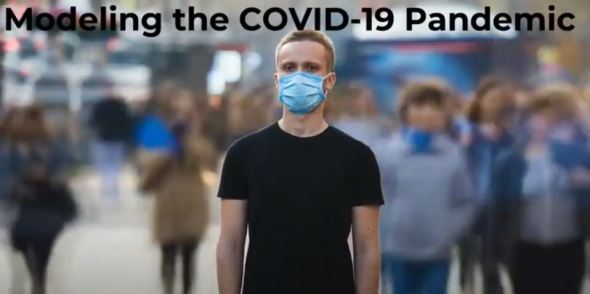
Today is the day. I submitted my super high level explainer video on how I modeled the COVID-19 about a week ago and I got an email from my professor telling me that it was great (yay) and that she had uploaded it to her labs youtube channel. That means I finally get to share it with all of you!
Day 240: Conferencing at a distance!

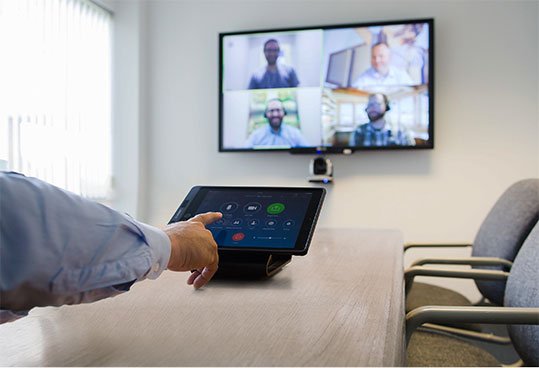
Not everyone has access to such luxurious setups.
It’s that time of the year again, well one of two times of the year really (for us anyway). Unfortunately with the coronavirus conferences are better held virtually than in person. While I have mixed feelings about the usefulness of meeting virtually to share our work, I am grateful that there are workarounds, don’t get me wrong, but there are some logistics that make it, well painful and some things that make this worthwhile.
Day 239: Review – Burst-modulated waveforms optimize electrical stimuli for charge efficiency and fiber selectivity
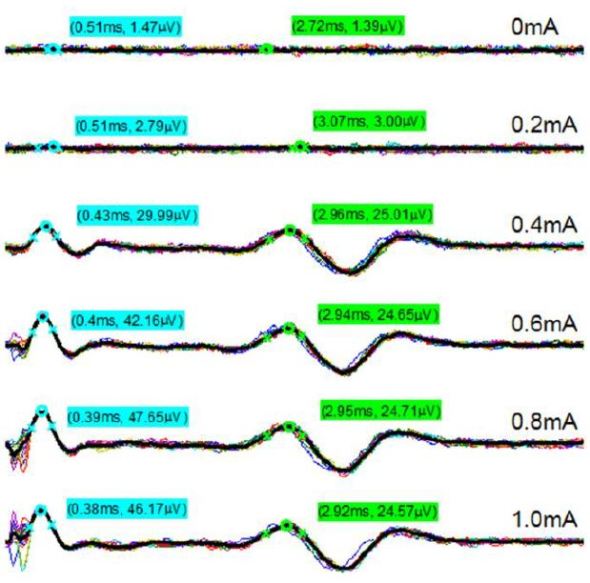
Example processed nerve responses during stimulation trials. The individual CNAP responses for each stimulus (thin traces) were averaged (thick trace, n=20 stimuli). All traces are shown from time 0 to 6ms. The top trace corresponds to an amplitude of 0, the bottom 1mA, and the traces in between are arranged in increments of 0.2mA. Peak latencies and heights (o’s) and widths at half peak height (x’s) were extracted from the averaged signal. The peaks labeled for the 0mA trial are due to noise and baseline activity. These peaks are not actual response peaks from the nerve and are ignored.
Another two weeks, another critical review and as always since my PI gets a copy, so do you. Technically this should’ve come yesterday, but I really wanted to follow up with the Roosevelt mess going on. In any case today we are looking at something not quite spinal cord stimulation, but has applications in the spinal cord stimulation field. Let’s take a look!
Day 236: Ugh, coder’s block

Okay, maybe not just coder’s block, but I feel like I’ve hit a wall. Every homework assignment I’m given for this class includes a “create your own problem and solve it,” element and for the first two assignments I feel like the topic sort of found me. We can talk about what those two projects were, but let’s first talk about this latest assignment.
Day 235: Video making issues

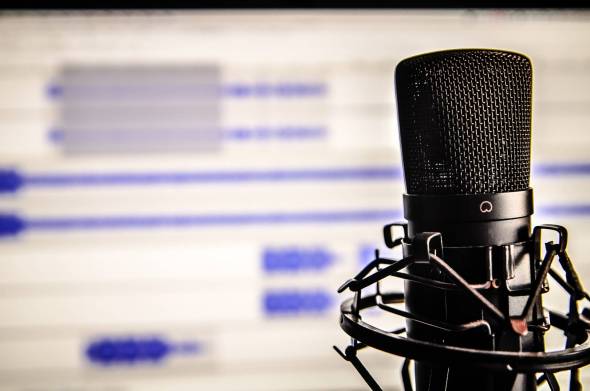
I’m not normally one for making videos, in this case I have to make (or rather narrate) two videos for this class. The first one was for our big class project and the second was explaining the COVID-19 model I created. It turns out narating isn’t as easy as it looks, even with a script.
Day 234: Learning… at a distance


Believe it or not, I don’t mind the quarantine. I mean sure going out without the fear of catching the coronavirus is nice, but I’m not generally a social person. There is one thing that has taken some getting used to however, that would be the education portion of the quarantine. Distance learning isn’t particularly enjoyable for me and I’m fairly sure I’m not the only one.
Day 233: Coronavirus modeling – Part 6
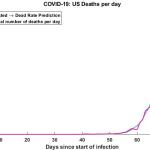
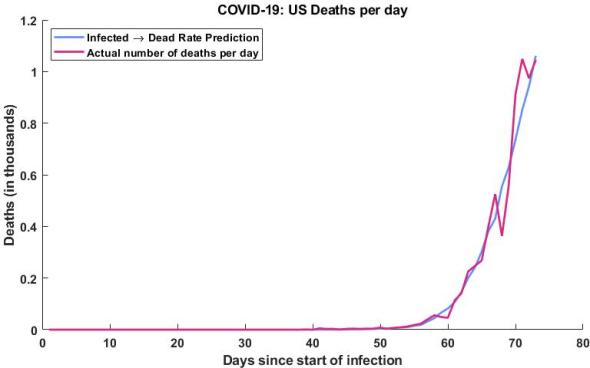
Model estimated death rate plotted in blue compared to the actual death rate plotted in purple. The model predicts deaths based on the previous infected datapoint, so it’s only predicting 1 day ahead, which is not very helpful. However, it lets me check that my model is running correctly.
Another day another unfortunate datapoint for my model validation. On one hand it’s good to be able to further validate my model, on the other, it’s heartbreaking to see it coming to pass. My model prediction isn’t pretty and the trend so far has been very similar to the model. Let’s talk about how we validate the model.
Day 232: Coronavirus modeling – Part 5
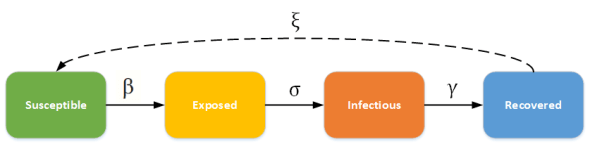
Well I did it! I finished my model to the best of my abilities. There are a few things I wish I had time to change or do differently, but I think that just comes from actually doing it and not having a clear idea of how I wanted to do it when I started. Let’s take a little look at some of the outputs from the model and I’ll talk a little bit on what the model is designed for, it’s limitations, and the things I wish I could’ve done differently
Day 231: Coronavirus modeling – Part 4

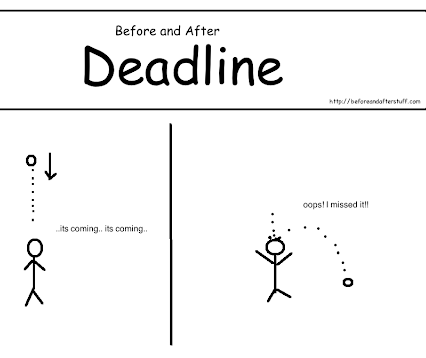
Still working on my model. It’s taking a little bit longer than I wanted it to take, but I’m getting somewhere finally… I think. In any case, I don’t have a lot of time for an update. So for now this is it. I’m making progress, but I still need to get it done before my deadline, which is fast approaching. Hopefully I can manage before then. Back to work I go!
Day 230: Coronavirus modeling – Part 3
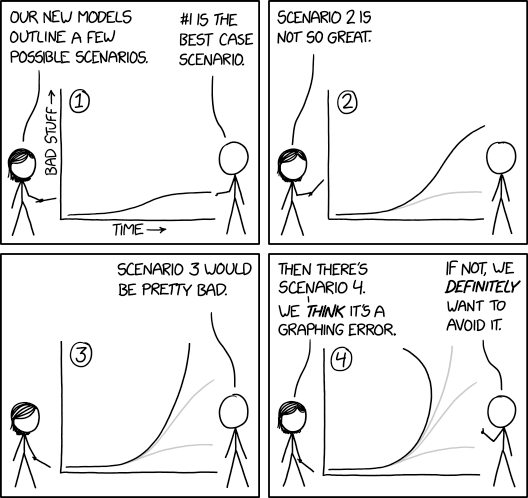
Comic by: XKCD
Well today will need to be short. I broke my model… on purpose, but it still broke. That means I need to go back and check my equations, make sure my assumptions are correct, then figure out why the heck I’m getting the results I’m getting. I have a good idea about what the problem is, I’m just not sure how I want to try to fix it.
Day 229: Coronavirus modeling – Part 2
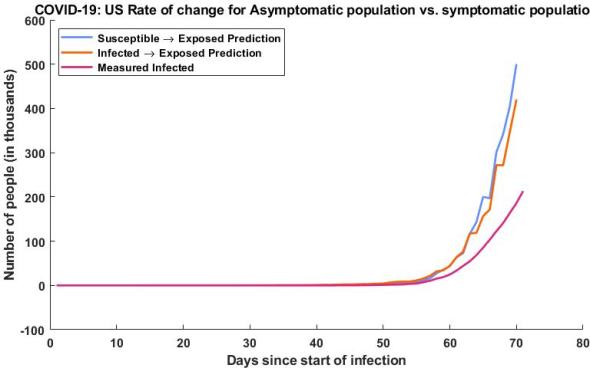
Here we have my estimated exposed population vs the measured infected population, the exposed population is calculated two ways, the first using our susceptible population dynamics (blue) and the second is using our measured infected rate (orange). This is compared to our measured infected since we would expect to see a much higher exposed (asymptomatic) population than infected (symptomatic) population, which we do.
I’ve made a lot of progress! Unfortunately, my model needs some more work and the code is pretty messy right now. For now, I’ll share some of my outputs and discuss what I need to do to finish my assignment. It turns out I have a few extra days to finish the work, I thought it was due Monday, instead it is due Wednesday. The slides and write up are going to take the longest so I’m still crunched for time even though I am mostly done. Let’s go over it.
Day 228: Coronavirus modeling – Part 1

Well the CO of the Roosevelt just got reprimanded just like I predicted. Ever predictable as usual, thanks military. In any case, that isn’t what we are talking about today. Today we are discussing the coronavirus model I’m creating, why it’s important and why no one should believe a model. I’m being slightly facetious, but read on and I’ll explain. I’ll even share some of my model results, it’s not finished, but I thought it would be interesting to share anyway.
Day 225: Class presentations


For the past week we have been utilizing online resources so that classes can continue while we are all social distancing. While this is means that we mostly use Zoom, we also have message boards and other resources that we can use. However, these resources are sometimes a poor substitute for in person classes. This is especially apparent when we have certain assignments for the class, such as a group presentation.
Day 224: Review – Cortical and Subcortical Effects of Transcutaneous Spinal Cord Stimulation
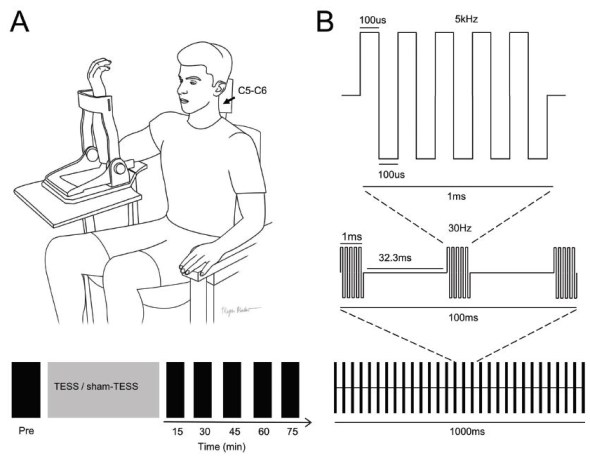
Experimental set-up. (A) Participants were comfortably seated in a customized chair during transcutaneous electrical spinal stimulation (TESS) or sham-TESS for 20 min. TESS was delivered using a surface electrode on the back of the neck between C5–C6 spinous processes segments (cathode) and a surface electrode in each anterior crest of the hip bone (anode) using a custom made 5 channel stimulator (BioStim5, Cozyma). Electrophysiological and behavioral outcomes were tested before (Pre) and immediately after, 15, 30, 45, 60 and 75 min after the end of the stimulation or sham stimulation period. (B) Schematic representation of the type of current used during TESS. We used 5 biphasic pulses at 5kHz with each biphasic pulse lasting for 200us. The middle scheme shows the blocks of 5 biphasic pulses passed at a 30Hz frequency. Lower part of the schematic shows the number of pulses delivered in one second.
Well it’s been two weeks since the last critical review so it’s that time again. As usual, my PI gets a copy and so do all of you. Since I’ve done several of these now (this is number six) I have a category just for these reviews called critical reviews. This is a really new study which tries to help tease apart what we are actually stimulating when we apply transcutaneous spinal stimulation. I think it’s a super interesting paper and I hope you do as well.
Day 223: Hell is other people


15th century art impression of Dante’s Lucifer from Inferno
Sure, Sartre didn’t mean that hell is literally other people, that is a common misconception and therefore the quote is often misused. However, I’m misusing it on purpose because right now in my situation, hell really is other people. Did I mention that I hate group work? I really do and as a change of pace I’m going to try to explain without the tangents I tend to take because it’s going to be a fairly long story.
Day 222: We’re still experimenting…?

Yesterday we did science. It’s a weird feeling to be doing science when there is a pandemic going on, but I actually enjoyed it. There is something about being in a small(ish) windowless room and getting to tune out the rest of the world for a few hours. Yes, I said a few hours, experimenting takes time. Things are in flux though, even for me when I seem to have the most consistent schedule out of our lab.
Day 216: So I’m “essential” now…


Fun fact, I love pandemic movies. Movies, not so much living through one. As humans we are selfish, greedy, prone to panic, and for being “evolved” we are so very, very stupid. Basically every dumb choice you see the characters in those movies make while screaming, “you idiot, that would never happen in real life!” Well, it’s happening and wow does it do a number on a persons mental health. But hey guess what? I’m essential, so let’s figure out what that means in a time where the world is practically on fire.
Day 215: What now?!


Social distancing is important, but maybe not this distant…
Well if you missed it, yesterday was our final post in the know your spinal cord series. I’m not crying, you’re crying! Now the question is, what does that mean for the blog? An excellent question, one I wish I would’ve asked myself! Let’s take a look at some of the things that we will (probably) be discussing now that our designated topic has run its course.
Know your spinal cord – The Recap
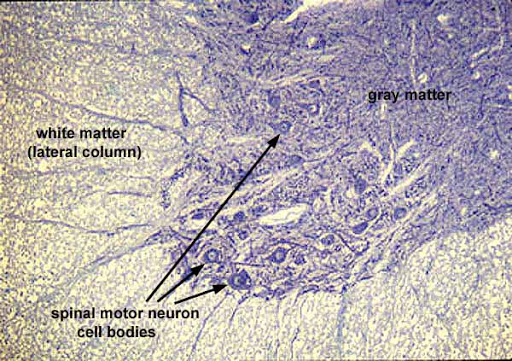
It’s day fifty-four and we’ve hit the end of our journey for this mini-series. For one last time, you can find all our posts in the neuroanatomy category. Everything comes to an end eventually and today I think we should do a small wrap up. This isn’t just a repeat of everything we went over though, we’re going to attempt to tie a lot of the topics together. So let’s give this a shot.
Know your spinal cord – Translating neural signals
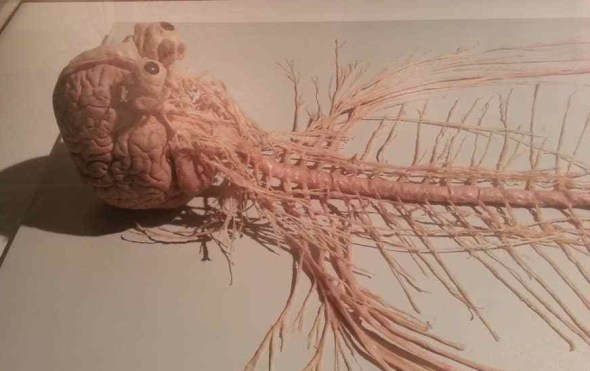
Here we are on day fifty-three, we are nearing the end for sure. I was going to end the series today, but there is at least one more thing that I think will be interesting to cover. As always, you can find all of our posts in the neuroanatomy category, after all there are quite a few now. Today we are going to talk about how the brain and muscles use different signals to communicate. Basically, they speak different languages; let’s talk about what that means.
Day 212: A small break
It was bound to happen, with the COVID-19 outbreak, my entire schedule has been shifting faster than I can keep up with it. I was going to force myself to write today, but I need a break. I’m exhausted both mentally and physically. There is a possibility I won’t be getting my stipend from the school this month, even though I’m still working, and I have assignments due soon, so I can’t dedicate the normal hour or so I would writing.
Friendly reminder, wash your hands, don’t touch your face, and practice social distancing. Even if you’re healthy, you can infect people that are not healthy or worse, people who work with others who are not healthy. Don’t be selfish! It may seem stupid now, but if we don’t do these things then it will get a lot worse and no one wants that. We can get through this if we all work together.
Know your spinal cord – Transcutaneous spinal direct current stimulation
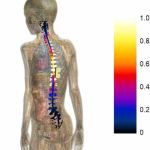
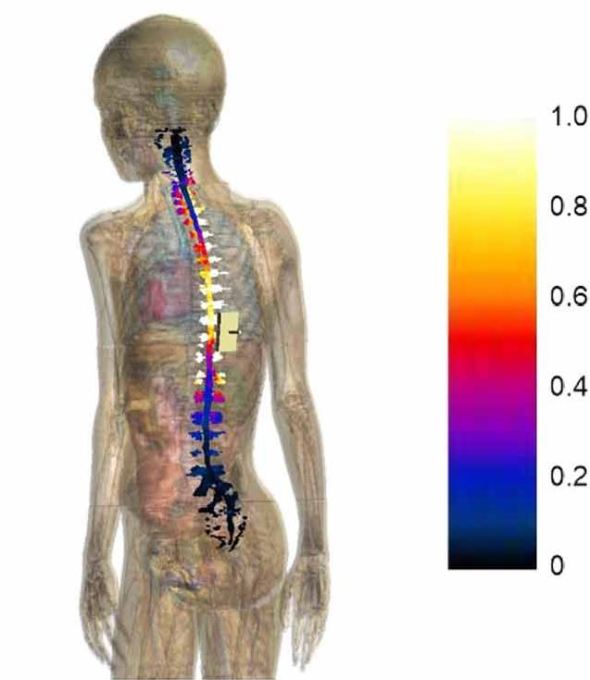
E amplitude distribution over the spinal cord and nerve surface. The color scale on the right is normalized with respect to the maximum of E amplitude in the spinal cord.
Well after our short break yesterday with my biweekly review paper, it’s back to the know your spinal cord series and we’re on day fifty-two! If you’re here for the first time, you can find the posts in this mini-series in the neuroanatomy category. We’ve taken a few twists and turns since we’ve started the series, but we’ve covered way more than I originally planned. We’ve covered how transcutaneous spinal cord stimulation is thought to work, that post focused on the type of spinal cord stimulation I’m researching. However, there are other ways to stimulate the cord. Transcutaneous spinal direct current stimulation (tsDCS) is a different way to stimulate and today we will talk about the difference.
Day 210: Review – Cervical trans-spinal direct current stimulation: a modelling-experimental approach
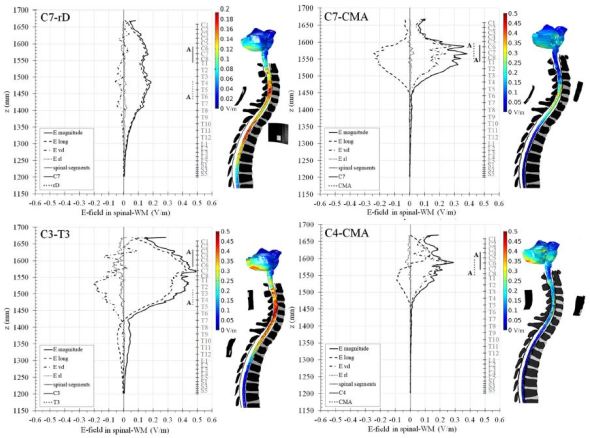
Average magnitude of the E-field and average amplitude of its components in the spinal-WM in all montages along the z axis. Position of spinal segments is marked on the grey vertical bar, electrodes are represented by vertical bars and active connectors are marked with letter “A”. Volume plots of the E-field magnitude in cervico-thoracic spinal-WM, brainstem and cerebellum are represented at the right of the average distribution in each montage, with the corresponding colour scales
I lied! I did know what today was going to be on, it’s the fifth critical review paper. Since my PI gets a copy, so do you! To be honest, I need to create a category for these reviews (Update: I did make a category, Critical reviews), but for now, my first looking at elbow spinal stretch reflexes is here. My second where I review modulating spinal cord excitability with a static magnetic field here. The third where I review modulating the H-reflex while walking in spinal cord injury populations. Lastly, my fourth on Motoneuron excitability during voluntary muscle activity in a spinal cord injury population can be found here. That said, let’s take a look at my latest review.
Know your spinal cord – Microglia
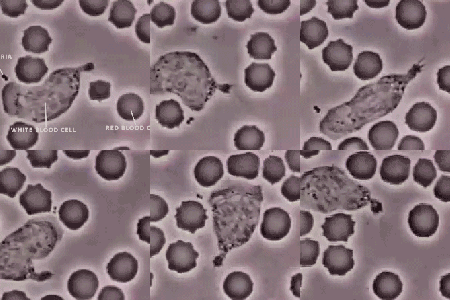
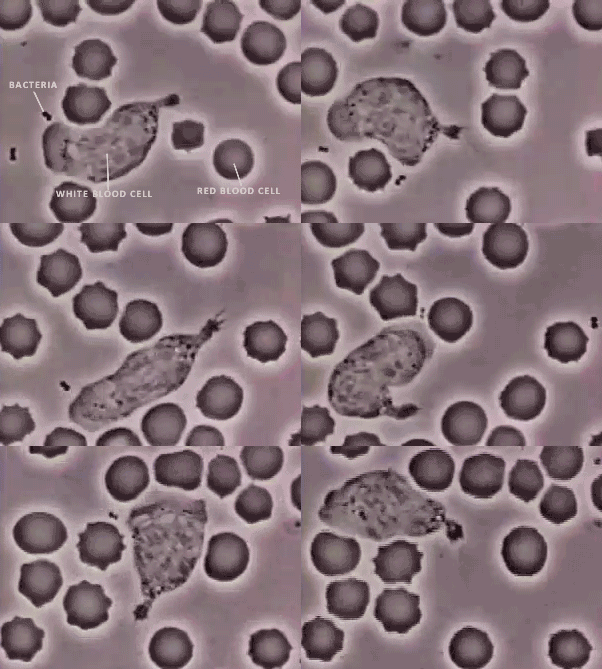
We cover this in the post, but it’s so cool I had to use it for the featured image.
It’s day fifty-one of knowing your spinal cord! For those of you who just found us, fear not we have all these posts in reverse chronological order listed in our neuroanatomy category. For everyone else, lately we’ve been talking about glial cells. This came about from the post on glial scarring which made me realize we should probably define glia. There are four types of glial cells found in the spinal cord (that we know of) we’ve covered three of them already and today we are talking about the last kind, the microglia.
Know your spinal cord – Ependymocytes
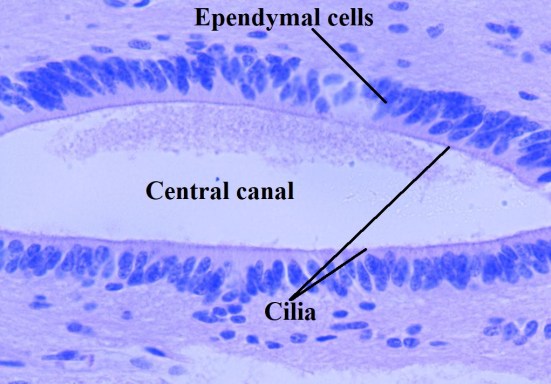
Ependymal cells, which create cerebral spinal fluid (CSF), line the ventricles of the brain and central canal of the spinal cord. These cells are cuboidal to columnar and have cilia and microvilli on their surfaces to circulate and absorb CSF.
We made it to yet another milestone, day fifty in our know your spinal cord series! As usual, you can find each and every one of these posts neatly organized in reverse chronological order using our neuroanatomy category. For the past couple of posts, we’ve introduced the types of glial cells, probably a bit poorly, but they are just so complex we can only really focus on a few of the functions. Needless to say they are very important cells. Today we are talking about the third (of four) types of glial cells found in the spinal cord (and brain), that is the ependymocyte. Let’s take a look.
Know your spinal cord – Astrocytes
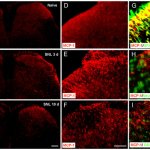
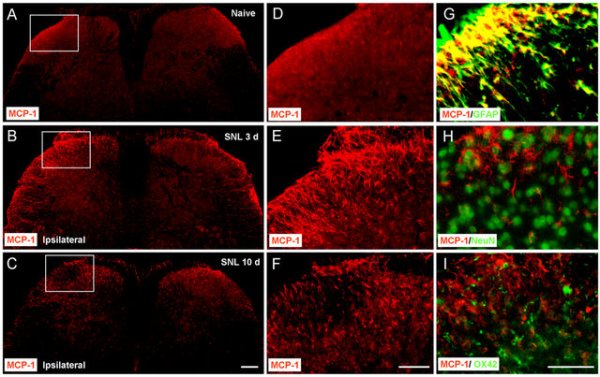
SNL induces MCP-1 upregulation in spinal cord astrocytes (A–C)MCP-1 expression in the spinal cord of naïve animals (A) and SNL animals at 3 days (B) and 10 days (C). Scale bar, 200 μm. (D–F) High magnification images of (A–C), indicated in the white boxes of A–C, show the dorsal horn of the ipsilateral spinal cord. Scale bar, 100 μm. (G–I) Double staining shows that MCP-1 is colocalized with GFAP, a marker for astrocytes (G), but not with NeuN, a marker for neurons (H) or OX42, marker for microglia (I). Scale bar, 50 μm. DOI: 10.1523/JNEUROSCI.3623-08.2009
Day forty-nine in the spinal cord series! You can find all the posts in this series in our super useful neuroanatomy category. A couple of posts back we introduced glial scarring, one of the problems we need to overcome to help people with spinal cord injuries. That led to the realization that we needed to introduce the glial cells, so yesterday we covered the oligodendrocytes and today we are talking about the astrocyte. Now that we have some background of how we got here, let’s introduce today’s topic.
Know your spinal cord – Oligodendrocytes
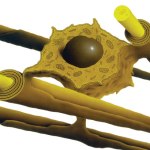
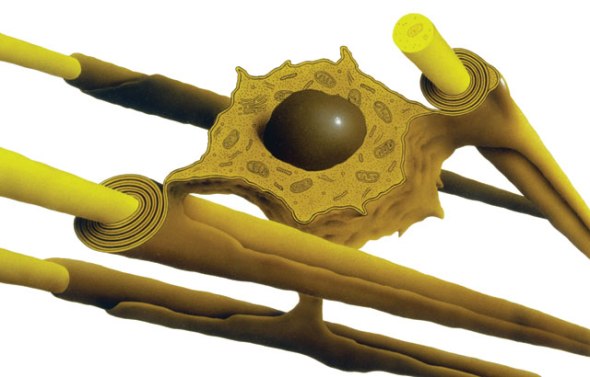
We made it to day forty-eight! As always, the neuroanatomy category will help you find each and every post in the spinal cord series. It’s all really good stuff! We mentioned yesterday that this was coming, we’re going to do a quick breakdown of the types of glial cells just to make understanding the glial scarring post easier. Plus it helps to understand the functions of glial cells in general when we talk about things that could go wrong. With that, let’s get into oligodendrocytes!
Know your spinal cord – Glial scarring
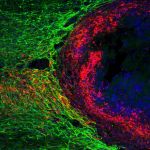
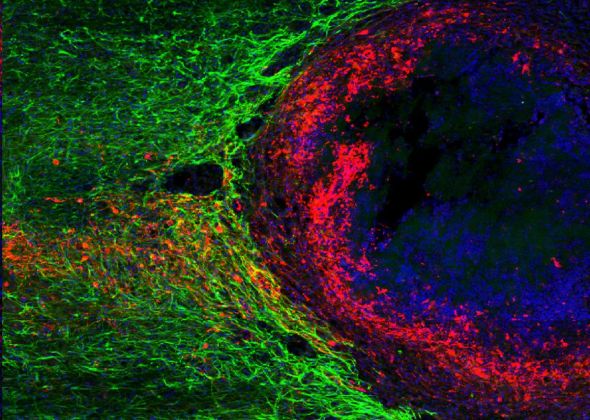
Previously injured nerve fibers (red) are shown regrowing through a dense astrocyte scar (green). UCLA research shows that astrocyte scars actually help support nerve fiber regeneration. You can read more about the study from UCLA here.
Here we are at day forty-seven of spinal cord posts. We are definitely wrapping up our series sad to say, maybe we can get to day fifty, that would be a nice round number to stop at. For those of you who want to read all the other posts, the neuroanatomy category has everything in reverse chronological order and will teach you everything from the medullary pyramids, the cauda equina, and all the stuff in between. Today we are talking about glial scarring and why it’s such a problem a topic I realized we should touch on after talking about the problems with invasive spinal stimulation methods yesterday.
Know your spinal cord – Invasive spinal stimulation techniques
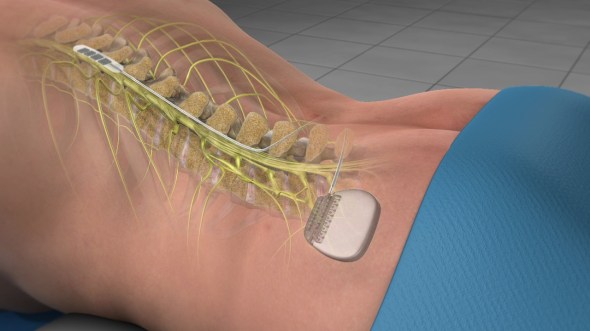
It’s day forty-six in our spinal cord series. While we’re nearing the end (maybe), there are still a few things to cover. First, if you’re new, you can find all of the posts in the neuroanatomy category for when you need a quick spinal cord fix. I’ve been debating about this post for some time, but I figure we might as well cover it since we’re here. Today we are going to talk briefly about invasive spinal stimulation and what the future might hold.
Know your spinal cord – Compound action potentials
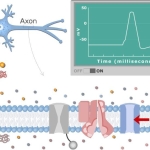
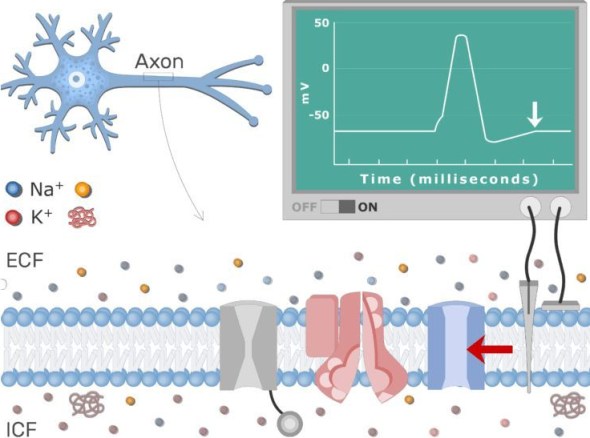
Image from: Get body smart
Day forty-five of the know your spinal cord series is here! With so many posts, you may be wondering how to find them all. Fear not, we have a super helpful neuroanatomy category for all your spinal cord needs. For the past few posts we’ve looked at some very interesting tools to probe the spinal cord. We’ve seen that there are quite a few ways we can go about it, but more importantly they all tell us something slightly different. Today we are looking at the product of that stimulation, the compound action potential.
Know your spinal cord – Transcutaneous Spinal Stimulation

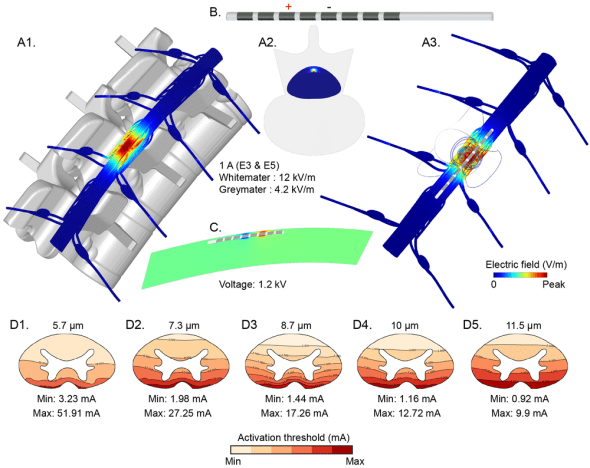
Welcome to day forty-four in the know your spinal cord series! As usual all of our posts are in a super easy to find neuroanatomy category. Now that we’ve covered our into into diagnostic tools to probe the spinal cord, let’s look at some of the ways we are working to help treat spinal cord injuries. Today we’re looking at a heavy hitter so to speak and something my research is focused on, transcutaneous spinal stimulation (TSS). Let’s take a look!
Know your spinal cord – The V-wave

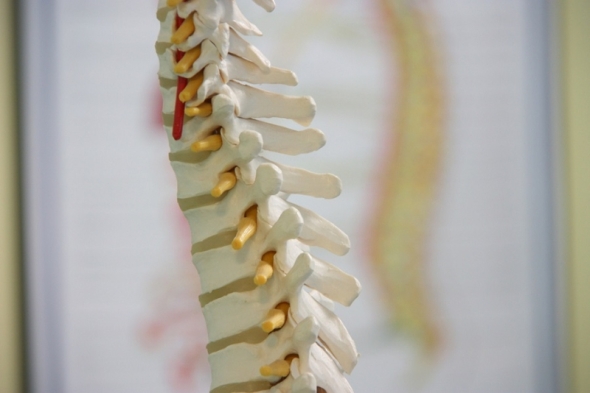
We’ve made it to day forty-three of our know your spinal cord series! While that is a lot of posts, we’ve made it super simple for you to find all of them with our neuroanatomy category. Lately, we’ve looked at several different tools in our spinal cord probing toolbox. We’ve seen all sorts of different ways to create a response, but we are still missing one important tool for our exploration into the unknown spinal cord world and that is what we are going to talk about today!
Know your spinal cord – Somatosensory evoked potentials
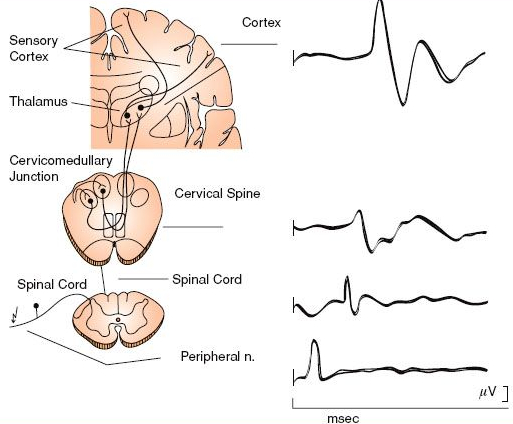
Somatosensory evoked potentials travel from peripheral nerves to the brain and we can record the response along the spinal cord and the brain non-invasively.
We’re back again with day forty-two of spinal cord knowledge series and day 200 in our 365 days of academia series! A friendly reminder that you can find each and every one of these posts in our very helpful neuroanatomy category. Yesterday we looked at motor evoked potentials, or electrical pulses that we create which travel from the brain to the muscles. Today we are looking at the almost reverse, signals we create originating in the peripheral nerves and arriving at the somatosensory cortex of the brain.
Know your spinal cord – Motor evoked potentials
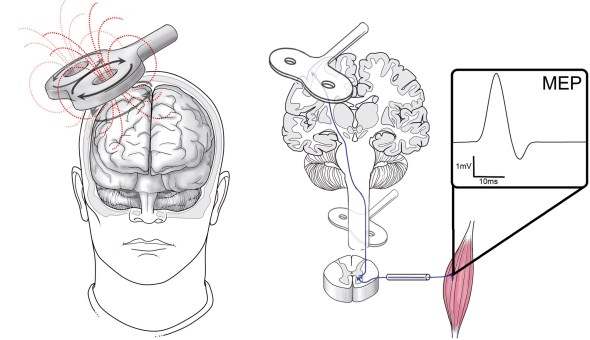
Transcutaneous magnetic stimulation (left) stimulating a portion of the motor cortex, which travels down the spine and activates a muscle (right)
Day forty-one in the know your spinal cord series. While the number of posts is going up, we made them easy to find by using our awesome neuroanatomy category! Maybe we did this a bit backwards, but it’s our series and this was the order we did it in. Yesterday we covered cervicomedullary motor evoked potentials, which is a subset of what we will be covering today. So again, slightly out of order, but hey let’s look at motor evoked potentials.
Know your spinal cord – Cervicomedullary motor evoked potentials
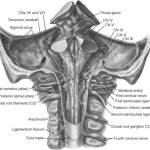
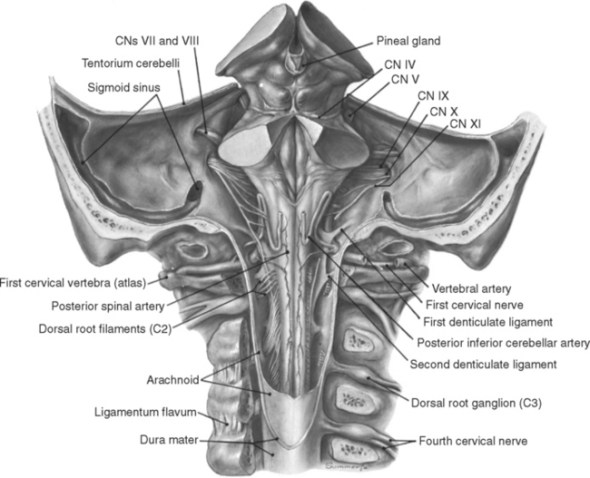
We made it, day forty in the know your spinal cord series! I honestly didn’t think we would get this far into things, but here we are. As per usual, if you’re new you can find all of the posts in this series in our super helpful neuroanatomy category! For the rest of you, or the ones interested in this topic, today we are looking at yet another tool in uncovering the secrets of the spinal cord.
Know your spinal cord – The F-wave
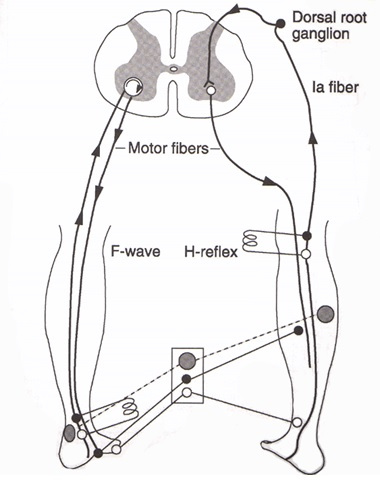
It’s day thirty-nine of our know your spinal cord series and we’re only touching the surface (so to speak)! If you’re just joining us, then welcome! You can find all of our spinal cord knowledge in the handy neuroanatomy category. Well as these things typically happen, yesterday brought up an interesting gap in our knowledge base. While I introduced the H-reflex, we never talked about the F-wave! So of course yesterday’s post probably left some of you scratching your head as to what an F-wave even is, fear not we’re going to clear that up today!
Day 196: Review – Changes in Motoneuron Excitability during Voluntary Muscle Activity in Humans with Spinal Cord Injury
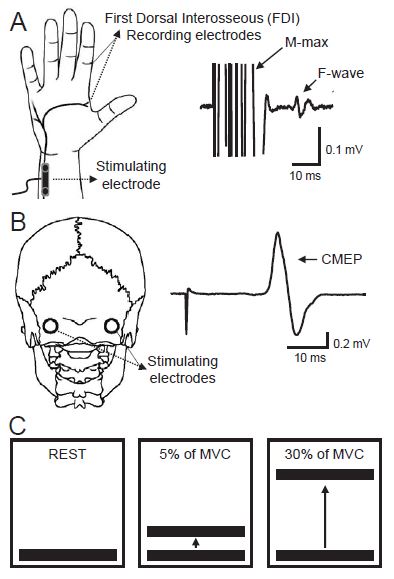
Figure 1. Experimental setup. A, Schematic representation of the hand showing the ulnar nerve and F-waves recorded from the first dorsal interosseous (FDI) muscle. B, On the left side, schematic representation of the head showing the electrodes placed at the cervicomedullary junction and on the right side a raw trace showing a cervicomedullary motor evoked potential (CMEP). C, A cartoon showing the concept of the visual feedback. Individuals were tested at rest (left single horizontal line) and during 5% (middle double horizontal lines) and 30% (right double horizontal lines) of maximal voluntary contraction (MVC).
A little detour from our spinal cord series for my fourth critical review paper. As usual, my PI get a copy and so do all of you! You can read my first looking at elbow spinal stretch reflexes here. My second where I review modulating spinal cord excitability with a static magnetic field here. Or the third where I review modulating the H-reflex while walking in spinal cord injury populations. Today is an interesting paper on motoneuron excitability while walking in spinal cord injury populations. It’s a really cool paper, so here’s my review.
Know your spinal cord – The spinotectal tract
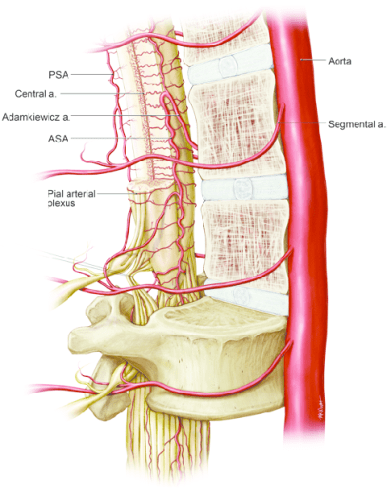
Welcome to day thirty-eight in the know your spinal cord series. As always, you can find the entire know your spinal cord series exclusively listed under our neuroanatomy category. We’ve amassed quite a bit of spinal information and I’ve gotten into more detail than I originally planned, which is part of the reason why we are going back and covering some of the things we skipped over. Today is one of those topics, we will be talking about the spinotectal tract, not to be confused with the tectospinal tract, which we already covered.
Know your spinal cord – The spinoreticular tract

We’ve arrived at day thirty-seven in the spinal cord series and we’re still covering new ground. You can find all of our sweet spinal cord action in the neuroanatomy category, which at this point is pretty extensive for a high-level look. Yesterday we talked about the reticulospinal tracts so today we are talking about the sister tract, the spinoreticular tract. Are they related, or is it all just in the name?
Know your spinal cord – The reticulospinal tracts


Reconstruction of the nuclear masses of the brain stem
It’s day thirty-six in our spinal cord series and I yesterday I lied, we’re not done quite yet. First, as always we have a super helpful neuroanatomy category for anyone wanting to read the posts from this series. For the rest of us, today we’re talking about the reticulospinal tracts, yes tracts with an s. There is a good reason for this, but you’ll have to read on to see why. (more…)
Know your spinal cord – The Tectospinal tract
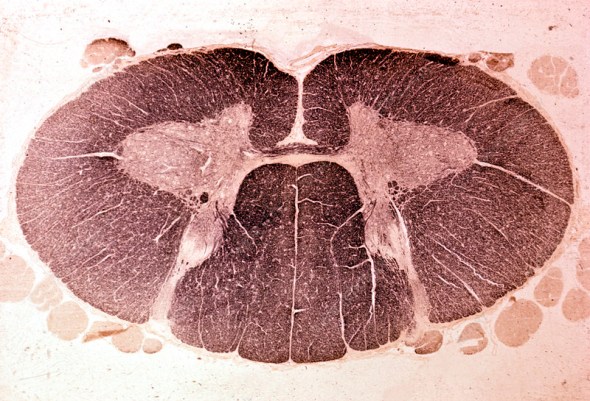
Welcome to day thirty-five in the know your spinal cord series! For the new people, we have a whole neuroanatomy category dedicated to these posts! For everyone else (or those of you just interested in today’s topic, this is going to be on another smaller tract of the spinal cord we haven’t covered yet. Today we are talking about the tectospinal tract, not to be confused with the spinotectal tract, so let’s get started.


 Lunatic Laboratories